Lights Out: What Really Happens When a Quasar Goes Dark
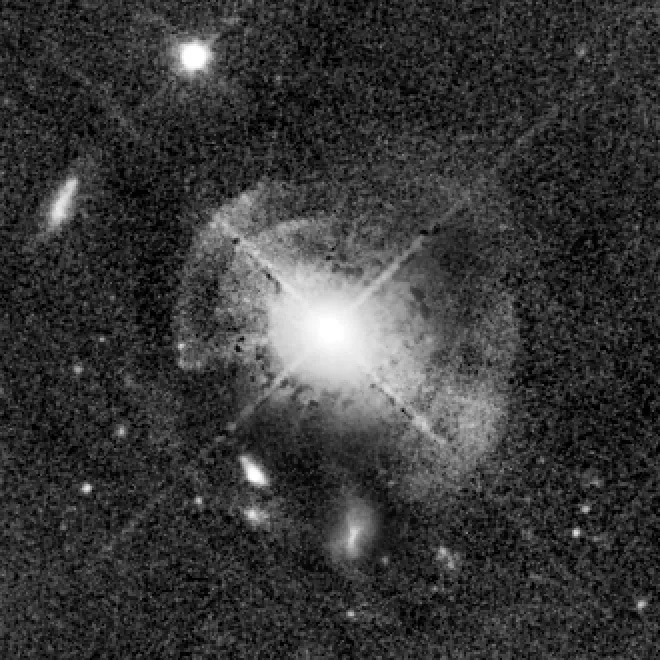
Photo: NASA, ESA, and G. Canalizo (University of California, Riverside), Public domain, via Wikimedia Commons
Imagine watching a lighthouse for decades. Same beam, same rhythm, night after night. Then one evening you look out and — nothing. The lighthouse is just... gone.
That's essentially what happened to a handful of astronomers staring at points of light billions of light-years away. Quasars, the most luminous objects in the known universe, don't have a reputation for subtlety. So when one vanishes from telescope views, scientists pay attention — and the story of why turns out to be one of the best windows we have into how galaxies live, eat, and eventually grow up.
First, a Quick Refresher on What You're Looking At
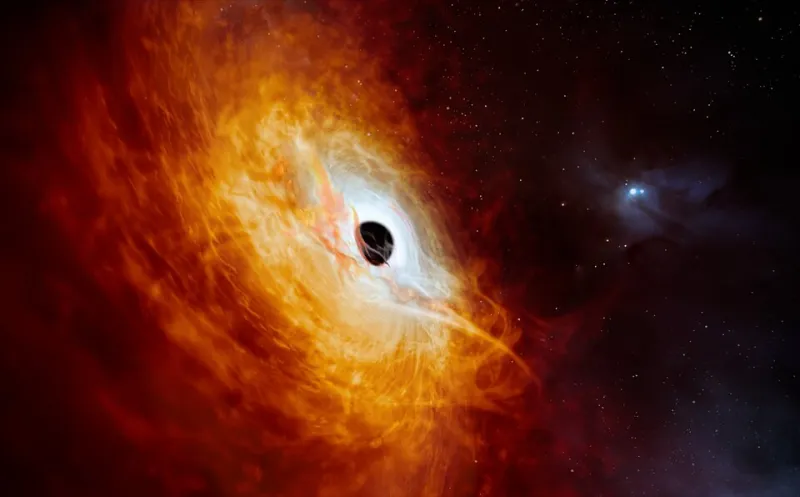
A quasar isn't a thing so much as a process. At the heart of nearly every large galaxy sits a supermassive black hole. Most of the time, that black hole is quiet — no material falling in, nothing to see. But when gas and dust wander too close, the inflowing matter heats up to staggering temperatures and blazes across the electromagnetic spectrum. That glowing feeding frenzy is what we call a quasar, and it can outshine every star in its host galaxy combined.
Here's the key insight: the black hole didn't go anywhere. Only the meal did. A quasar switching off is less like a star dying and more like a restaurant closing for the night — the kitchen's still there, there's just nothing on the menu.
The Case of the Missing Quasar
Astronomers first got seriously spooked when comparing old sky surveys with modern observations. Objects that blazed brightly in photographic plates from the mid-20th century — many taken with telescopes like the ones at Palomar Observatory in California — had simply faded to near-nothingness in contemporary surveys.
Skeptical minds had good questions. Was the galaxy still there but shrouded? Was some gravitational trick bending light away from us? Teams went to work ruling out alternatives one by one:
- Dust blocking the view: If thick dust had drifted in front of the quasar, infrared light would still leak through. In several cases, it didn't. The object wasn't hidden — it was genuinely dark.
- Gravitational lensing games: A foreground galaxy can act like a cosmic magnifying glass, briefly boosting a quasar's brightness before dimming it. But lensing leaves telltale signatures — duplicated images, specific brightness patterns. These vanishing acts didn't match.
- Data errors or misidentification: Cross-checks across multiple instruments and wavelengths confirmed the fading was real.
The verdict: these quasars had actually switched off. The black holes had stopped feeding.
How Do You Turn Off the Brightest Light in the Universe?
The physics is surprisingly relatable. Quasars are messy eaters. When a black hole gulps down gas, radiation pressure from the feeding process can actually blow away the surrounding fuel — a kind of self-limiting binge. Once the gas supply is exhausted or expelled, the light show ends, sometimes within a human lifetime or less. On galactic timescales, quasars may flicker on and off like faulty neon signs.
That's a big deal for our models of galaxy evolution. A quasar's intense radiation doesn't just shine — it pushes. The energy released can heat and expel gas from the galaxy entirely, shutting down star formation and transforming a lively star-forming galaxy into a quiet, reddened one. In other words, a quasar's death may be part of how galaxies like our own Milky Way settled into the calm, mature state we see today.
What a Dormant Quasar Leaves Behind
Here's the poetic part: every big galaxy, including ours, probably hosted a quasar once. Sagittarius A*, the black hole at the center of the Milky Way, is currently on a strict fast — millions of times lighter than the beasts that power the brightest quasars, and with almost nothing to eat. But look at the evidence of ancient activity around it, and you'll find hints that our galactic core had its wild years.
Studying quasars that winked out recently — cosmically speaking — lets astronomers catch the transition in progress. It's like finding a restaurant mid-renovation: you can see what changed, what got blown out, and what the neighborhood looks like after the party's over.
Why This Matters to the Rest of Us
There's something quietly humbling in all of this. The universe's most extreme lighthouses aren't permanent fixtures — they're phases. Galaxies have life stages, and we happen to live in one that's past its quasar prime.
And for amateur astronomers and citizen scientists, vanished quasars are one of the few cosmic phenomena where old data genuinely matters. Digitized archives of century-old astronomical plates have helped identify objects that faded within decades — a reminder that sometimes the biggest discoveries aren't made by looking harder, but by looking back.
So the next time you hear that a quasar disappeared, don't think of it as a light going out. Think of it as a black hole finishing dinner — and a galaxy, at long last, growing up.