Crash Course in Cosmic Dining: Why Galaxy Collisions Light the Quasar Fuse
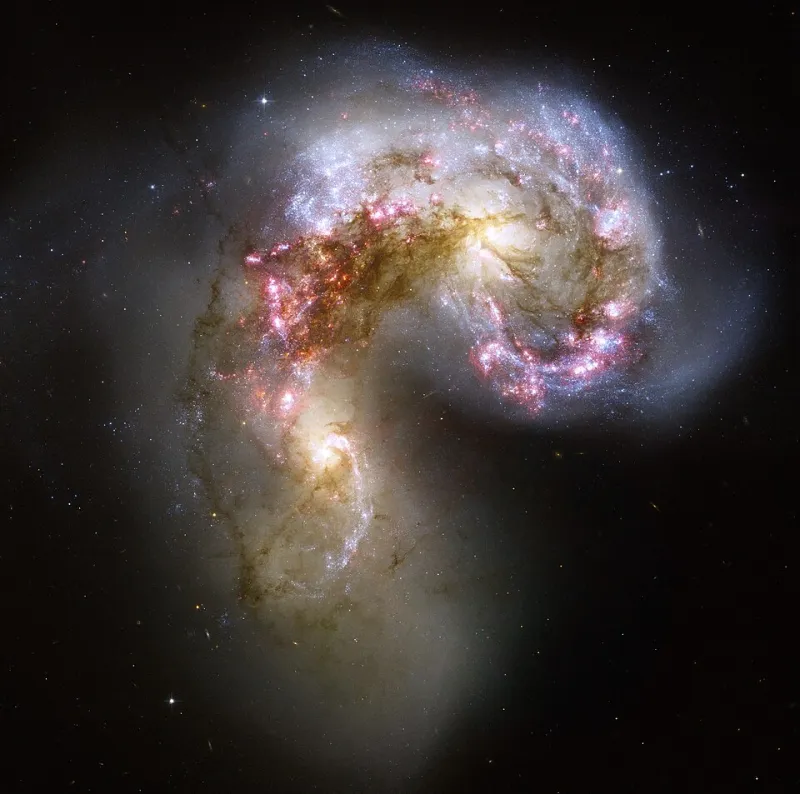
Photo: NASA, ESA, and the Hubble Heritage Team (STScI/AURA)-ESA/Hubble Collaboration, Public domain, via Wikimedia Commons
Picture two cars meeting at an intersection. Now blow that image up a few trillion times, add hundreds of billions of stars, and stretch the crash across hundreds of millions of years. That's a galaxy merger — and according to decades of observations, it's also the universe's favorite dinner bell.
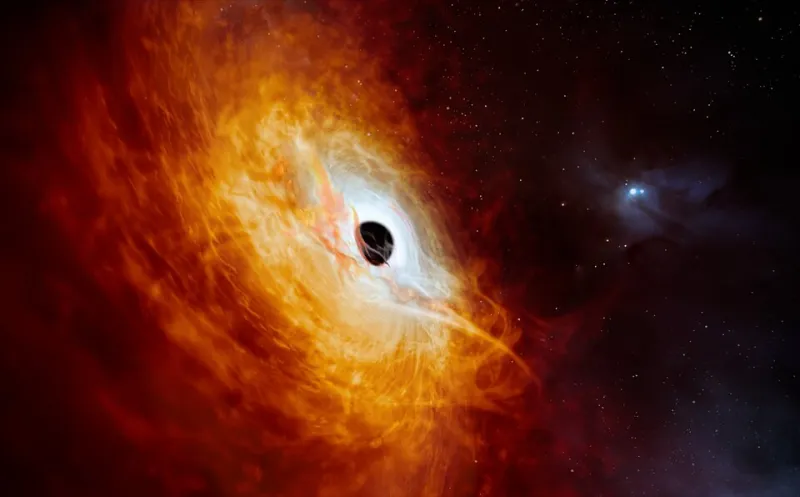
When two galaxies collide, something remarkable often happens at the center of the wreckage: the supermassive black hole that's been quietly napping for eons suddenly wakes up, starts devouring surrounding gas, and blazes into a quasar bright enough to outshine every star in its host galaxy combined. The question is, why does a crash make a black hole eat?
The Long, Slow Fender Bender
First, let's clear up a common misconception. Galaxies don't "collide" the way cars do. They're mostly empty space — the stars within them are so widely separated that during a merger, almost no two stars actually touch. If the Milky Way and Andromeda were two pennies, the individual atoms inside them would still never meet.
What does collide is gas. Huge clouds of hydrogen, the raw fuel for star formation and black hole feeding, slam into each other, compress, and heat up. And that's where things get interesting for our sleeping giant at the galactic center.
Gravity's Downward Spiral
Here's the mechanics of it. In a normal, undisturbed spiral galaxy like our own Milky Way, gas orbits the center in a relatively orderly disk. The central black hole — in our case, Sagittarius A*, a modest 4-million-solar-mass beast — sits there with very little to eat. Starved black holes are dim. Nobody writes home about them.
A merger wrecks that order completely. As the two galaxies swing past each other and eventually coalesce, their gravitational fields stir the gas like a spoon in coffee. Tidal forces fling long streams of gas outward, while dynamical friction — essentially the gas dragging against itself — robs it of angular momentum and causes it to rain inward toward the center.
Think of it like a drain in a giant sink. Normally the water (gas) swirls around lazily. Rattle the whole sink, and suddenly a huge fraction of that water rushes straight down the drain. The drain, in this case, is a black hole with an appetite.
The Timeline: From First Embrace to Full Blaze
Astronomers have pieced together a rough schedule of how one of these events unfolds, thanks to simulations and observations of systems caught at every stage:
First approach (tens of millions of years): Two galaxies fall toward each other under mutual gravity. Tidal tails — vast arcs of stars and gas — begin to stretch out. If you look at telescope images of merging pairs, these tails are the telltale signature, like gravitational fingerprints at a crime scene.
First and second passes (tens to hundreds of millions of years): The galaxies swing past each other, sometimes more than once, each pass stripping away more gas and slowing them down. Star formation often spikes dramatically during this phase as gas clouds collide and collapse.
Coalescence (a few hundred million years in): The galaxies finally merge into one. Gas that survived the chaos now loses its orderly orbit and funnels toward the center. This is the critical moment — the gas delivery system switches on.
Quasar phase (tens to hundreds of millions of years): The black hole, suddenly gorging on this inflow, lights up. The accretion disk around it glows so fiercely that a quasar can be visible from 12 billion light-years away. Eventually, the black hole eats through the available fuel or blows it away with radiation pressure, and the light fades. Dinner's over.
The Evidence Is Written in the Sky
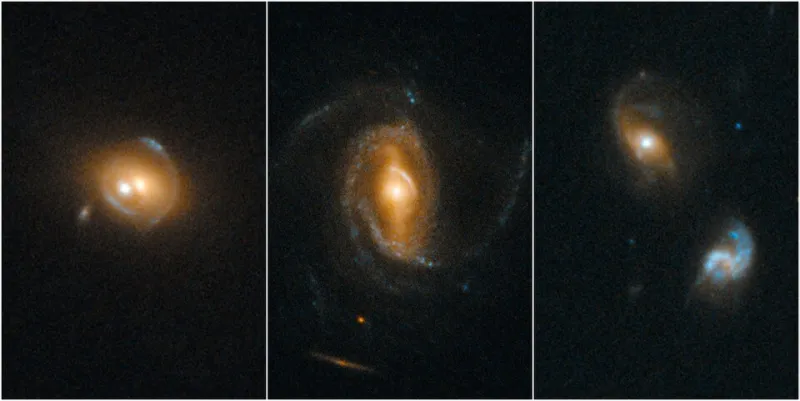
This isn't just a pretty theory. Surveys of quasar host galaxies consistently show that a large fraction of them show signs of recent mergers — distorted shapes, tidal tails, double nuclei. Quasars, it turns out, love company.
Some famous examples are visible with modest equipment. NGC 4038 and 4039, the famous "Antennae Galaxies" in Corvus, are two spirals mid-collision, their tidal tails splayed across the sky. A small telescope from a dark site can catch them, and they're a favorite target at star parties across the American Southwest. Further along the timeline, NGC 6240 in Ophiuchus harbors two supermassive black holes spiraling toward each other — a merger caught in the act, with both monsters potentially destined to feed.
And in roughly 4 billion years, the Milky Way and Andromeda will write the next chapter of this story ourselves. Our own Sagittarius A* may get a meal it won't soon forget.
Why It Matters Beyond the Fireworks
Quasar ignition isn't just spectacle — it's feedback. The radiation and winds from a feeding black hole can heat and expel gas from the entire galaxy, shutting down future star formation. In a very real sense, these merger-triggered feasts help decide what kind of galaxy a system grows up to be: a lively spiral full of newborn stars, or a quiet elliptical full of aging ones.
So the next time you're out under a dark sky — say, at a campground in Utah or a field in rural Pennsylvania — take a moment with the Antennae if you can. You're not just looking at a fuzzy patch. You're watching the early stages of a meal that will take hundreds of millions of years to finish, with a black hole waiting patiently at the table.
The universe's brightest lights, it turns out, start with a crash.