All You Can Eat, Then Nothing for a Million Years: The Weird Diets of Supermassive Black Holes
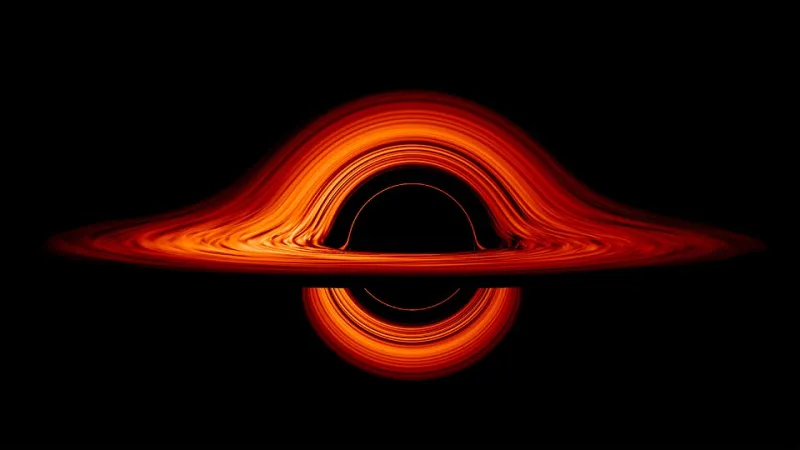
Photo: NASA’s Goddard Space Flight Center/Jeremy Schnittman, cmglee, CC BY-SA 4.0, via Wikimedia Commons
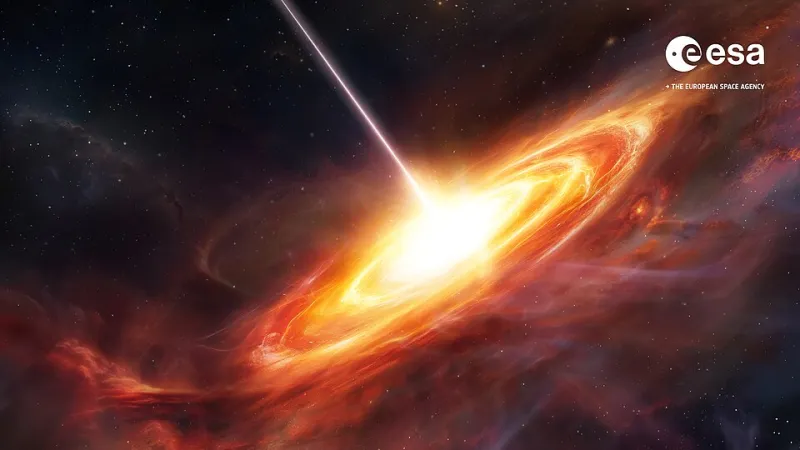
Picture the most extreme eating contest imaginable. Now multiply it by a factor that breaks your calculator. The brightest quasars in the universe — the ones Quasarborn loves to obsess over — can consume roughly one to ten Suns' worth of gas and dust every year. Some of the greediest ones tear through a sun's mass in a matter of days.
And yet, just down the cosmic street, another supermassive black hole might be eating absolutely nothing. Not a slow trickle. Nothing. It could stay in that fasting state for millions of years before suddenly firing back up.
What gives? Why do black holes, the universe's most famous gluttons, have such dramatically different diets?
The Buffet Is Open (If You Can Find It)
Here's the counterintuitive part: black holes don't actually "suck" things in. That's a Hollywood invention. An object orbiting a black hole at a safe distance just... orbits. Same as it would around a star of equal mass.
For a black hole to eat, food has to fall into it. That means matter needs to lose enough angular momentum — essentially, slow down its sideways motion — to spiral inward. In practice, that only happens when there's a lot of gas crammed into a small region: a colliding galaxy, a destabilized gas cloud, a star torn apart by tidal forces.
Think of it like a buffet. The food being out isn't enough. You need a crowd, some shoving, and enough chaos that people end up at the serving table whether they planned to or not.
Grazers vs. Gorgers
Astronomers have informally sorted black-hole feeding behavior into two camps, and the analogy is almost too perfect.
The grazers feed steadily but modestly. Seyfert galaxies — the quieter cousins of quasars — host black holes sipping gas at a low simmer. Their accretion disks glow, but you wouldn't spot one from billions of light-years away. They're the person nibbling celery at the party.
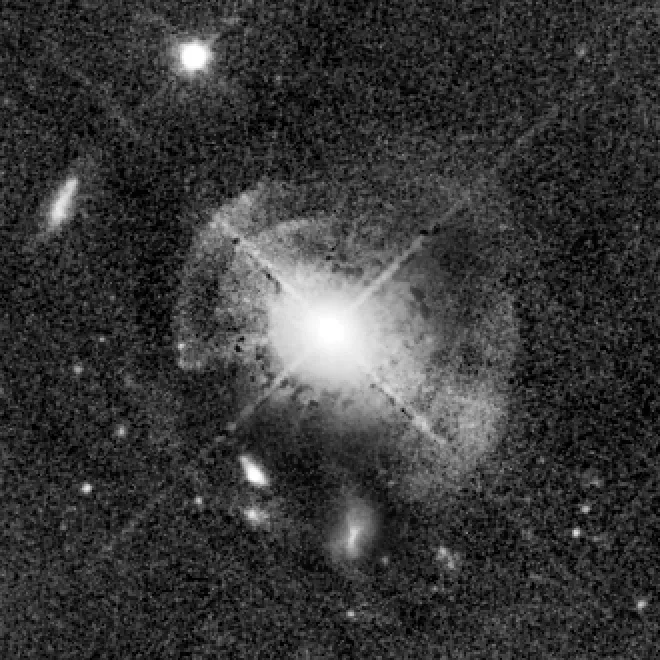
The gorgers are the quasars themselves. When a galaxy merger funnels huge amounts of gas toward the center, the black hole feasts. All that infalling material compresses and heats to millions of degrees, blasting out radiation across the electromagnetic spectrum. A single quasar can outshine every star in its host galaxy combined — often by a factor of a hundred or more.
The catch? Gorging is temporary. The gas supply runs out, or the black hole's own radiation blasts the remaining food off the table. Which brings us to the strangest part of the story.
The Speed Limit Nobody Can Break
There's a hard ceiling on how fast a black hole can eat, and it comes from a surprisingly elegant piece of physics called the Eddington limit.
Here's the logic. As matter falls in, it releases radiation. That radiation pushes outward on the surrounding gas. Feed too fast, and the outward pressure of light overwhelms the inward pull of gravity — the buffet literally blows itself off the table. The black hole starves itself of the very food it's trying to eat.
The Eddington limit describes the exact balance point. For a supermassive black hole, it's roughly a Sun's worth of mass per few hundred thousand years — modest-sounding until you remember it can continue for millions of years straight.
Some quasars, though, appear to exceed it, hitting so-called super-Eddington accretion rates. The details are still debated, but the general idea is that in a dense, messy disk, radiation can escape through narrow channels while gas keeps pouring in — like eating through a crowded kitchen where some of the steam vents out the back door.
Why does this matter? Because the Eddington limit sets the growth clock for every black hole in the universe. It's the reason astronomers scratch their heads at the billion-solar-mass behemoths JWST keeps finding in the early universe. Growing that big, that fast, means eating at or above the limit almost continuously from nearly the moment of the Big Bang. No skipping meals allowed.
The Long Nap
So what about the black holes that aren't eating at all?
Our own Milky Way's central black hole, Sagittarius A*, is a prime example. It's four million times the mass of the Sun, and right now it's basically dormant — flickering weakly as the occasional gas blob drifts too close. If you'd pointed a telescope at the Milky Way's core ten billion years ago, you might have seen a blazing quasar instead.
Dormancy can last an astonishingly long time. Some galaxies show evidence that their central engines switched on and off on timescales of millions of years. And every so often, we catch one waking up in real time. In recent years, astronomers have flagged galaxies where a previously quiet nucleus suddenly brightened — events nicknamed "changing-look quasars." A black hole that was a cosmic wallflower for eons flips the switch and starts blazing.
The trigger? Usually a fresh food delivery: a gas cloud, a shredded star, or a small galaxy merging in and dumping its cargo at the center.
Why the Appetite Matters
This isn't just trivia about cosmic eating habits. Black-hole feeding is tangled up with galaxy evolution in ways astronomers are still untangling.
When a quasar rages, its radiation and outflows can heat or expel the gas in the host galaxy — the raw material for new stars. In other words, the black hole's diet may determine whether its galaxy keeps forming stars or shuts down production entirely. The eater, in a very real sense, shapes its own pantry.
So the next time you see a gorgeous image of a distant quasar, remember what you're looking at: a black hole at maximum capacity, radiating furiously because it's eating as fast as physics allows. And somewhere out there, its dormant cousin is sleeping through the same universe, waiting for the next meal to arrive.
Patience, apparently, is a virtue — even for the hungriest objects in existence.