Flashlight Through the Fog: The Genius Trick That Lets Us X-Ray the Cosmic Web
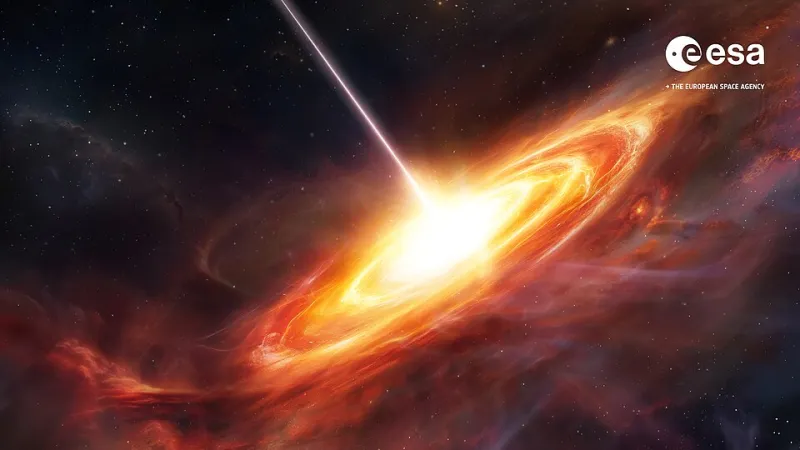
Photo: European Space Agency, CC BY-SA 3.0 igo, via Wikimedia Commons
Here's a puzzle worthy of a bar bet: how do you map something that's mostly invisible?
The cosmic web — that vast scaffolding of dark matter filaments and diffuse hydrogen gas that threads between galaxies — makes up most of the universe's structure. And you can't photograph it directly. It doesn't glow. It doesn't twinkle. It just... sits there, soaking up light.
But absorbing light is the tell. If something drinks photons, you can catch it in the act — as long as you've got a bright enough lamp behind it.
Enter the quasar: nature's searchlight.
The Backlight Principle
Think about standing on a foggy highway at night. You can't see the fog itself, but when a car rounds the bend with its high beams on, suddenly the fog is everywhere — outlined, defined, measurable. The car isn't illuminating the fog for your benefit. It's just trying to get home. But the light it throws gives you a picture of the air you're standing in.
Quasars are the high beams of the cosmos. Powered by supermassive black holes feeding at a frantic pace, they can outshine a trillion suns, and their light travels for billions of years before reaching telescopes here on Earth.
Along the way, that light passes through clouds of gas — some leftovers from galaxy formation, some thin wisps along dark matter filaments, some fresh and pristine from the early universe. Each cloud imprints a barcode on the light, absorbing specific wavelengths depending on what it's made of and how fast it's receding from us.
When astronomers spread that light into a spectrum, they don't just see a quasar. They see a stack of mugshots — every gas cloud the light ever mugged through on its 12-billion-year journey.
Reading the Barcode
The most famous of these barcodes is the Lyman-alpha forest. Sounds like a national park in Wyoming, but it's actually a thicket of absorption lines in a quasar's spectrum, each one caused by neutral hydrogen in a different gas cloud at a different distance.
Because the universe is expanding, light gets stretched — redder — as it travels. A cloud that absorbed the light 10 billion years ago leaves its mark at a different spot on the spectrum than one that intercepted it 5 billion years ago. The result is like tree rings or sediment layers: a core sample of cosmic history, drilled in a straight line from the quasar to your telescope.
Count the lines, and you know how much hydrogen is out there. Track how the lines cluster, and you've mapped the hidden skeleton of dark matter that gas clings to. Density fluctuations in the Lyman-alpha forest have even been used to weigh the universe itself and test whether gravity behaves the way Einstein said it should.
One quasar gives you a pencil-thin slice of the sky. Line up a few hundred, and you get something remarkable: a three-dimensional tomogram of the cosmic web, built entirely from shadows.
Cartography by Committee
That's exactly what the Baryon Oscillation Spectroscopic Survey (BOSS) and its successor eBOSS did using the telescope at Apache Point Observatory in New Mexico. Teams of American astronomers and their international colleagues cataloged hundreds of thousands of quasars, then used their overlapping absorption fingerprints to reconstruct a map of the universe's middle age — billions of years of history compressed into a single 3D chart.
More recently, the Dark Energy Spectroscopic Instrument (DESI) in Arizona has been running the same play with vastly better resolution, using quasar sightlines to pin down how dark energy has stretched the cosmic web over time. Every faint smudge of hydrogen between here and a quasar is a data point in the biggest survey humanity has ever attempted.
It's a little ironic. Quasars were once considered nuisances — contaminating specks that messed up galaxy counts. Now they're the workhorses of observational cosmology.
Can Backyard Stargazers Play Along?
Here's the honest answer: you won't detect the Lyman-alpha forest from your driveway. The absorption lines sit in the ultraviolet for nearby quasars and get stretched into the deep red only for the most distant ones, which requires serious telescope time and sensitive spectrographs.
But you can absolutely appreciate the cartography, and here's how.
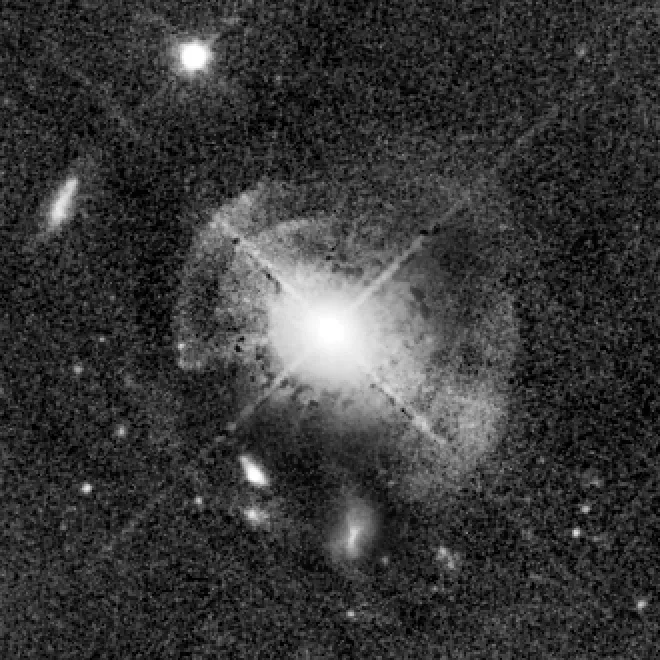
See a quasar with your own eyes. 3C 273, in the constellation Virgo, shines at magnitude ~12.9 — reachable with an 8-inch telescope from a dark-sky site, and a genuine rite of passage for amateur astronomers. You're looking at something 2.4 billion light-years away, the farthest thing most backyard scopes will ever resolve. Check star charts from Sky & Telescope or use planetarium apps to find it during spring evenings.
Explore real spectra for free. The Sloan Digital Sky Survey's SkyServer lets anyone browse actual quasar spectra online. Pull one up and look for the forest of absorption dips — you're reading the same data the professionals use.
Follow the maps. When DESI or SDSS releases new cosmic web visualizations, they're public. Some are genuinely gorgeous — filaments of matter stretching across hundreds of millions of light-years, all inferred from backlit fog.
Why It Matters
Quasar spectroscopy answered one of cosmology's biggest questions: where did the missing ordinary matter go? The answer was hiding in thin, nearly invisible gas between galaxies — the so-called missing baryons — and quasar light found it.
The same technique keeps probing dark matter, dark energy, and even the fundamental constants of physics (some quasar spectra suggest the fine structure constant might vary across the universe, though that's still hotly contested).
All of it, from a flashlight pointed at fog. Not bad for objects we didn't even confirm until the 1960s.