The Universe's Ultimate Power Plants: Meet the Quasars Outshining Entire Galaxies
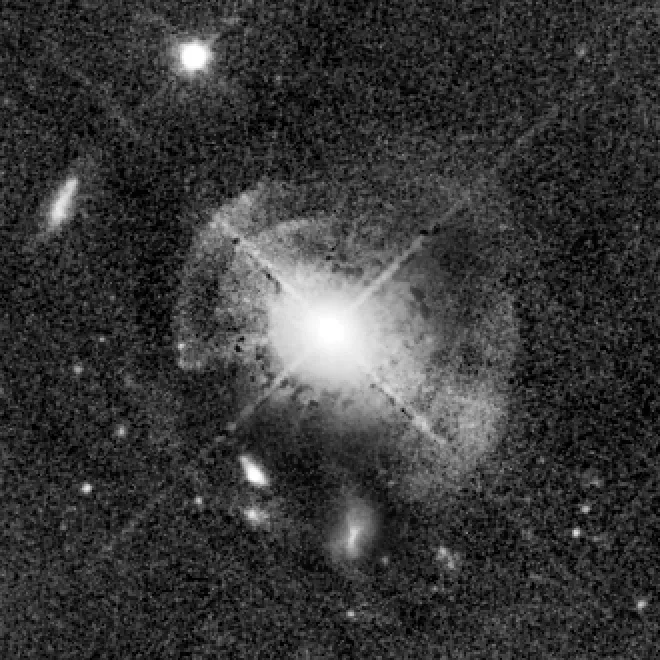
Photo: NASA, ESA, and G. Canalizo (University of California, Riverside), Public domain, via Wikimedia Commons
Picture a single point of light that outshines every star in the Milky Way combined. Not a star, not a supernova — a region of space smaller than our solar system, pouring out more energy than a trillion suns. That's a quasar, and honestly, we named this site after them for a reason.
So What Exactly Is a Quasar?
The word quasar is short for "quasi-stellar radio source," a clunky name astronomers gave in the 1960s when these things showed up on surveys looking like stars but behaving like nothing else. Today we know they're anything but stars.
A quasar is what happens when a supermassive black hole goes into feeding overdrive. Every large galaxy has one of these monsters at its center — ours included, a sleeping giant called Sagittarius A*. But when gas, dust, and entire stars spiral toward a black hole, they don't fall straight in. Instead, they whip around into a spinning disk, heated by friction to temperatures of millions of degrees.
That superheated infalling matter glows across the entire electromagnetic spectrum. The black hole itself emits nothing — it's black, after all. The light show comes from the traffic jam of material waiting in line.
Why So Bright?
Here's the counterintuitive part: a black hole converting matter to energy is staggeringly efficient. Nuclear fusion, the process powering the sun, converts less than 1% of matter's mass into energy. Matter falling into a black hole can convert around 10% or more. That's roughly ten times the bang for your buck.
A quasar in full swing can blast out 10 to 100 times the luminosity of our entire galaxy. Some of the record holders make a trillion suns look dim. And because that energy comes from a region smaller than Neptune's orbit, quasars look like point sources — star-like beacons — even though they're really galactic engines.
Seeing Back in Time
Quasars are mostly a feature of the universe's youth. The brightest ones flourished billions of years ago, when galaxies were young and gas-rich, giving central black holes plenty to eat. Many modern galaxies, including ours, have quiet black holes because the food supply ran out.
That's great news for stargazers: because quasars are so absurdly luminous, we can detect them from over 13 billion light-years away. Every quasar you observe is a window into the early universe. You're not just looking across space — you're looking back in time, at light that left before the sun even existed.
Your Backdoor to the Deep Universe: Observing 3C 273
Want to see a quasar with your own eyes? You can, and you don't need an observatory in the Atacama Desert. From dark skies in the US — think rural Arizona, the Texas hill country, or a certified Dark Sky site — a modest telescope will do.
The classic target is 3C 273 in the constellation Virgo. It was the first quasar ever identified, back in 1963, and at magnitude 12.9 it's the brightest quasar visible from Earth. That's far too faint for the naked eye but well within reach of a 6-inch or larger telescope.
Here's your game plan:
- When: Spring is quasar season in the Northern Hemisphere. Virgo rides high on April and May evenings.
- Where to look: Find Virgo's bright star Porrima (Gamma Virginis), then use a star chart or a planetarium app to hop to the field around 3C 273, a bit over a degree north-northeast of Porrima.
- What to expect: Don't expect fireworks. You'll see a faint, star-like point. But knowing that pinpoint of light is over 2.4 billion light-years away — that its photons left home before multicellular life existed on Earth — changes everything.
- Pro tip: Use high magnification on a steady night and avert your vision slightly to catch the faint point. Sketch the star field and compare it against a chart to confirm you've got the right dot.
Other quasar targets for ambitious observers include 3C 48 and the blazar Markarian 421, which can brighten enough for smaller scopes when it flares.
Why We Care
Quasars helped shape the galaxies we live in. Their outbursts heat and blow away gas, regulating star formation across entire galaxies. Astronomers even use quasar light shining through distant gas clouds as a cosmic backlight, probing the chemistry of the early universe.
They're lighthouses, really — fixed beacons we navigate by. And the best part? One of them is waiting in Virgo this spring, just a star-hop away from your backyard.
Clear skies, and happy hunting.