The Monster Next Door Is on a Diet: What It Would Take to Wake Up Sagittarius A*
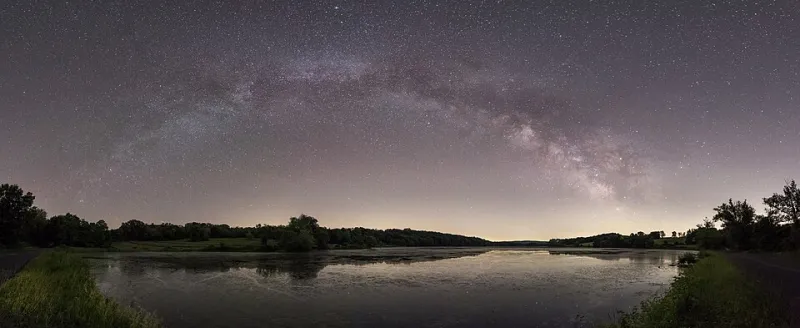
Photo: Juliancolton, CC BY-SA 4.0, via Wikimedia Commons
Somewhere around 26,000 light-years away — directly over your shoulder if you're reading this in the Northern Hemisphere on a summer night — sits a black hole with the mass of 4 million Suns. And it's doing absolutely nothing.
Astronomers call Sagittarius A* (Sgr A* for short) a "quiescent" black hole, which is the polite scientific way of saying it's on an extended fast. Compare it to the blazing quasars we spotlight here at Quasarborn — objects that outshine entire galaxies — and our homegrown monster looks almost embarrassing. But here's the kicker: it doesn't have to stay that way. Given the right meal at the right time, the Milky Way's own center could light up as a genuine quasar, visible in the sky above your backyard.
Let's walk through how that could actually happen, how bright it would get, and why nobody at NASA is losing sleep over it.
Why Our Black Hole Is Currently Fasting
A black hole only shines when it eats. Matter spiraling inward heats up to millions of degrees, radiating ferociously across the spectrum before crossing the point of no return. No infalling gas, no glow — just a dark gravitational fingerprint.
Sgr A*'s problem is a supply issue. The region around it, called the Central Molecular Zone, holds plenty of gas in principle, but most of it orbits stably at a distance, like water in a reservoir behind a dam. The black hole is fed through a trickle: occasional clumps of gas that wander too close get shredded and briefly flare. In 2019, the object known as G2 — possibly a gas cloud with a star hidden inside — grazed the black hole. Astronomers expected a fireworks show. Sgr A* barely burped.
That's the pattern. Our galaxy's heart simmers on leftovers while distant quasars feast on entire stars' worth of gas every year.
The Realistic Wake-Up Calls
So what would it take to move Sgr A* from fasting to feasting? Astronomers have a shortlist, and it's all about delivery logistics.
Scenario one: a gas cloud takes the plunge. The most common trigger in other galaxies is simple gravity. A molecular cloud drifting through the galactic center gets tidally stretched — spaghetti-fied, if you will — and a fraction of its gas loses enough orbital energy to spiral inward. If a cloud tens of thousands of times more massive than the Sun dropped in, the accretion disk could ignite within thousands of years, which is practically overnight on galactic timescales.
Scenario two: a dwarf galaxy gets devoured. This one has precedent written all over it. The Milky Way is currently shredding the Sagittarius dwarf galaxy, and streams of its stars wrap around our entire galaxy. Simulations show that when a satellite galaxy falls in, a significant chunk of its gas can be funneled all the way to the center. Some astronomers suspect that's exactly what switched on quasars in the Milky Way's past — evidence suggests our galactic center flared up a few million years ago, and the faint "Fermi bubbles" above and below the galactic plane may be the afterglow of that meal.
Scenario three: a star gets torn apart. Rarer, but spectacular. A star straying too close gets ripped to shreds in a tidal disruption event, briefly pouring months of luminous debris into the black hole. It wouldn't be a lasting quasar, but it would be a light show.
How Bright Would "The Quasar Next Door" Actually Be?
Here's the fun part. Suppose Sgr A* kicked into a moderate quasar — nothing record-breaking, just a typical active galactic nucleus pumping out energy at, say, a few percent of the Sun's output.
At 26,000 light-years, that translates into something genuinely striking in our sky. Depending on the accretion rate and how much dust blocks the view, estimates range from a brilliant point of light outshining every star in the night sky, all the way to a beacon rivaling the full Moon. Picture a second, bluish-white "star" near the constellation Sagittarius that doesn't twinkle, casts shadows, and messes with every dark-sky preserve from Arizona to Maine.
Amateur astronomy as we know it would change overnight. Deep-sky objects — the faint galaxies and nebulae that backyard observers chase through telescopes — would wash out under the glare. Planetariums would need new slides. Light pollution complaints would get a lot more philosophical.
Before You Panic: The Friendly Fine Print
Could a awakened Sgr A* hurt us? The short answer from every astronomer who's run the numbers: no.
We're 26,000 light-years from the action, and the dangerous radiation from an active nucleus — the intense X-rays and gamma rays — travels outward in a relatively narrow cone along the black hole's spin axis. Our solar system sits well off to the side, in the galactic suburbs. The main effects would be optical: a spectacular new light in the sky and some extra high-energy radiation filtered safely by our atmosphere.
The bigger long-term story would be environmental. An active nucleus can heat and blow away gas across the galaxy, potentially slowing future star formation. That's a story measured in millions of years, though — not a Tuesday problem.
The Waiting Game
So when might the switch flip? Honestly, nobody knows. The gas supply near the center suggests our black hole will stay on its near-starvation diet for the foreseeable future. But the Sagittarius dwarf galaxy is still being pulled apart, and its remaining gas has nowhere to go but eventually inward. Some models hint the Milky Way could host another modest active phase within a few hundred million years — right around when the Andromeda collision gets serious.
In other words, the quasar next door isn't a matter of if, but when. And when it happens, you won't need a telescope, a subscription, or a trip to a dark-sky site in Nevada. You'll just need to walk outside and look up at the brightest thing you've ever seen.
Sleep tight, monster. We'll be watching.