The Universe's Funhouse Mirror: How a Single Quasar Can Show Up Four Times in Your Eyepiece
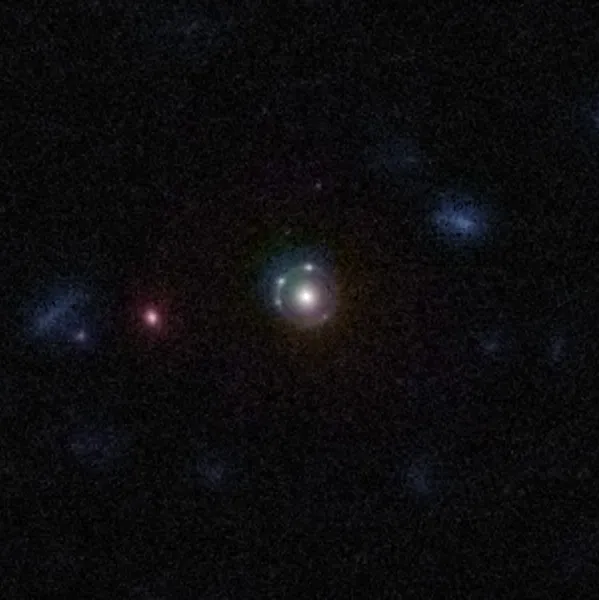
Photo: NASA, ESA, C. Faure (Zentrum für Astronomie, University of Heidelberg) and J.P. Kneib (Laboratoire d'Astrophysique de Marseille), Public domain, via Wikimedia Commons
Picture this: you're at a star party in the Nevada desert, someone hands you the eyepiece, and you're told that the four little dots you're looking at are actually one object. Not a cluster, not a coincidence — one single quasar, split into four by gravity itself.
Welcome to the cosmic funhouse mirror.
Gravity: The Original Optical Illusion
Einstein figured out more than a century ago that mass bends space, and light — being a good traveler — follows the curves. When a massive galaxy sits almost directly between us and a distant quasar, its gravity warps the quasar's light around it, the way the rim of a wine glass smears the candle flame behind it.
Depending on how perfectly aligned things are, the result can be two images, four images, or even a glowing ring called an Einstein Ring. The alignment rarely needs to be perfect — just close enough that the galaxy acts like a very lumpy, very heavy lens.
And here's the kicker: the quasar didn't move, split, or multiply. Your telescope, and every professional instrument on Earth, is seeing copies of the same light that took slightly different routes around the lensing galaxy.
Einstein's Cross: The Classic Party Trick
The most famous example is a quasar about 8 billion light-years away, sitting behind a relatively nearby galaxy in Pegasus. Astronomers, clearly having fun with naming conventions, call it Einstein's Cross (technically Q2237+0305).
The foreground galaxy is only about 400 million light-years away — practically a next-door neighbor by quasar standards — and its gravity splits the background quasar into four bright points arranged around the galaxy's core. In long-exposure photographs it looks like a tiny square of light with a fuzzy center, like a cosmic jack-o'-lantern face.
Spotting it yourself takes patience: an 11- or 12-inch telescope, excellent seeing, and genuinely dark skies. It sits high in the fall sky for Northern Hemisphere observers, which is good news for backyard astronomers across the US.
The Double Act: Q0957+561
If the Cross is too much of a challenge, start with the first gravitational lens ever identified, back in 1979: the "Twin Quasar" in Ursa Major. Two fuzzy dots, a few arcseconds apart, that turned out to be the same object. Doubled, not twinned.
It's reachable in an 8-inch scope under dark rural skies, and there's a satisfying irony to it: the object that taught astronomers lenses exist is the easier one to find. Bring a star chart, because it sits in a fairly plain patch of sky near the edge of a galaxy cluster.
Microlensing: Weighing the Invisible
Now for the part that gets astrophysicists genuinely giddy.
Inside that lensing galaxy are stars — and each individual star adds its own tiny ripple of gravity. When one of those stars drifts in front of one of your quasar images, it briefly brightens that image, then fades as it moves on. This is microlensing, and it's essentially the universe tapping you on the shoulder to say, "there's a star here you can't see."
Because quasars are so astonishingly compact — a light source smaller than our solar system outshining a trillion suns — these flickers are measurable. Astronomers watch the four images of Einstein's Cross brighten and dim out of sync with each other, and from those mismatched light curves they can deduce how much matter, including dark matter, is piled up along the light's path.
Think about that. We're using a quasar 8 billion light-years away as a flashlight to weigh things we cannot see, in a galaxy we can barely resolve, all because gravity can't resist bending light.
Time Delays: The Universe's Slow-Motion Replay
One more trick worth knowing about. Because each lensed image takes a slightly different route around the lensing galaxy, the light from each copy arrives at slightly different times — sometimes weeks or months apart.
When a quasar flares, one image brightens first, and its twin follows later, like a delayed broadcast. Astronomers use these time delays to measure cosmic distances independently, which feeds directly into one of the biggest ongoing arguments in science: how fast the universe is expanding. The Hubble tension — the mismatch between different measurements of that expansion — gets tested, in part, with lensed quasars.
So that little smudge in your eyepiece? It's part of a live debate about the fate of the cosmos.
Your Observing Hit List
Want to try this yourself? Here's a realistic starter list:
- The Twin Quasar (Q0957+561) — Ursa Major, best in spring evenings. An 8-inch scope from a dark site should do it.
- Einstein's Cross (Q2237+0305) — Pegasus, fall skies. Bring 11+ inches of aperture and low expectations.
- SDSS J1004+4112 — a quasar lensed into five images by a galaxy cluster in Leo Minor. Photography territory; visual detection is brutal, but the story is worth the effort.
Use a detailed chart rather than a phone app at the eyepiece — these are faint, small targets, and the difference between the quasar images and a random field star is subtle.
The Mirror That Keeps Giving
There's something wonderfully human about the whole enterprise. We built billion-dollar telescopes to study the most violent objects in existence, and the universe responded by bending their light through a cosmic prism, splitting them into copies of themselves.
Instead of complaining, astronomers grabbed the distortion and turned it into a tool — one that finds exoplanets, maps dark matter, and measures the expansion of everything.
The funhouse mirror, it turns out, tells the truth. Just from a weird angle.