Riding the Plunge: A First-Person Guide to Falling Into Sagittarius A*
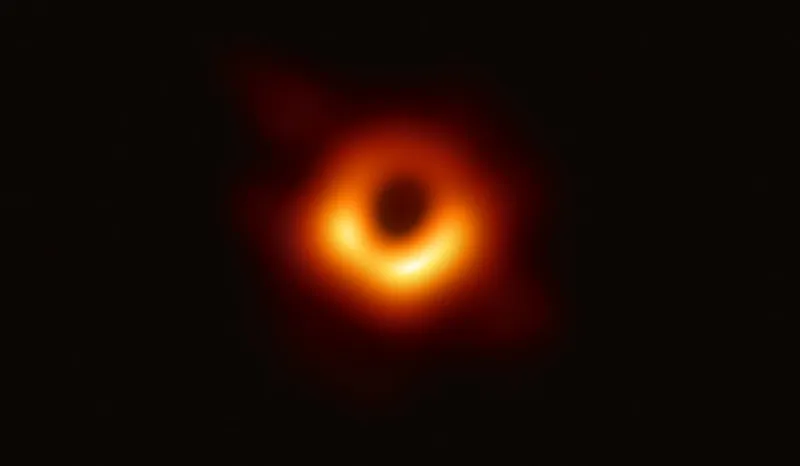
Photo: Event Horizon Telescope, CC BY 4.0, via Wikimedia Commons
Let's say you win a lottery that shouldn't exist: a spacecraft, infinite fuel, and about 26,000 light-years of free time. Your destination is Sagittarius A* — the supermassive black hole anchoring the center of our galaxy, the same one immortalized in that famous orange donut photo from the Event Horizon Telescope. You're not going to orbit it. You're going in.
Fair warning: this is a one-way trip. But as thought experiments go, it's the best physics lesson in the universe, because every stage of the fall teaches you something real about how space and time work.
The Long Approach: A Quiet Suburb of the Galaxy
For most of the journey, Sagittarius A* is a no-show. Black holes don't glow; they reveal themselves by what happens around them. As you close in, you'd watch stars whip past in impossibly tight, fast ellipses — stars like S2, which brushes the black hole at roughly 3% the speed of light every 16 years.
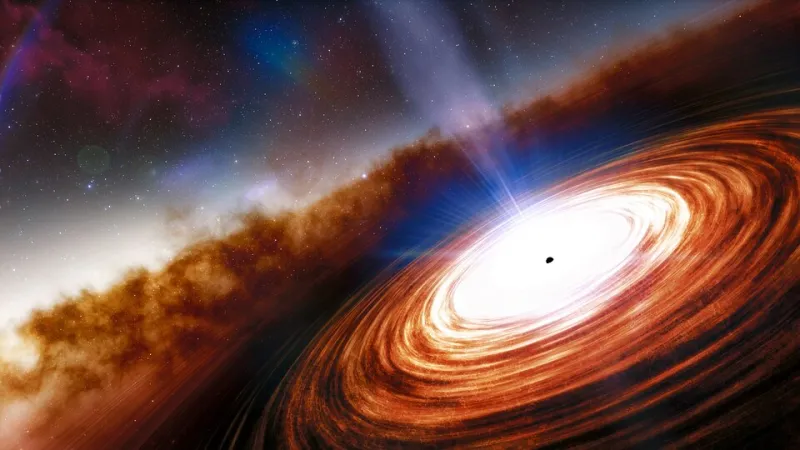
Then your view starts to warp. The black hole's gravity bends light so severely that you can see things behind it, wrapped around it like light through the edge of a drinking glass. The accretion disk — a thin, superheated swirl of gas — appears both above and below the object simultaneously, because light from its far side is getting folded over the top. It's less like looking at an object and more like looking at a knot in spacetime.
The Point of No Return: Crossing the Event Horizon
Here's the strange part: nothing dramatic happens when you cross the event horizon. No wall, no flash, no cosmic tollbooth. The event horizon isn't a surface — it's a mathematical boundary, the distance where the escape velocity equals the speed of light. Cross it, and every direction you can point, including backwards, leads inward.
For a supermassive black hole like Sgr A* (about 4.3 million times the Sun's mass), the tidal forces at the horizon are actually gentle. That's the counterintuitive bit: the bigger the black hole, the softer the entry. You'd sail across without feeling a thing. The drama comes later.
Spaghettification: The Universe's Weirdest Stretching Routine
Gravity's pull gets stronger the closer you get — and critically, it pulls harder on the near side of you than the far side. Physicists call this a tidal force. Astronomers, who apparently have a sense of humor, call the result spaghettification.
As you fall feet-first, your feet get tugged harder than your head, and sideways, gravity squeezes you like a tube of toothpaste. First you'd feel a mild pull, like a stretch on a good massage table. Then the stretching accelerates. Eventually — and we're talking well before any rescue mission could matter — the difference in pull between your head and toes exceeds what your body can handle. You become a stream of atoms, drawn out into a thin ribbon of matter spiraling inward.
The consolation prize? Some of your atoms might briefly join the accretion disk, heat up to millions of degrees, and shine as X-rays. You'd, technically, become a quasar-adjacent light source. Small comforts.
Time Gets Weird: Your Clock vs. Everyone Else's
Meanwhile, back on Earth, your friends with a really good telescope would see something totally different. Thanks to gravitational time dilation, light from your ship gets increasingly redshifted and slowed as you approach the horizon. From their perspective, you never actually cross it. You'd appear to slow down, dim, and redden — a fading snapshot hovering at the edge forever, like the universe's saddest freeze-frame.
From your perspective? You crossed the horizon in finite time and kept falling. Both views are correct. General relativity doesn't care about making things tidy.
The Final Descent: Where Physics Throws Up Its Hands
Deeper in, things get genuinely strange. Space and time effectively swap roles — inside the horizon, falling toward the center becomes as inevitable as moving forward into next Tuesday. And at the very center lies the singularity, the point where our equations divide by zero and every known law of physics formally resigns.
Nobody knows what happens there. Quantum mechanics and general relativity, our two best theories, flatly contradict each other at that scale. You'd be the first person to find out, and the last person able to file a report.
Why Bother Imagining Your Own Demise?
Because this thought experiment is how physicists actually think. The stretching, the frozen image, the horizon you cross without noticing — these aren't sci-fi flourishes. They're the real, tested predictions of Einstein's equations, confirmed by watching stars orbit Sgr A* and by imaging its shadow in 2022.
You don't need a spaceship to appreciate it. The next clear night, look toward the constellation Sagittarius — just off the spout of the teapot asterism. Somewhere in that direction, 26,000 light-years away, sits a monster that could stretch you into spaghetti and slow your clock to a crawl. Sweet dreams.