The Universe's Steadiest Metronome: What a Spinning Black Hole Can Teach You About Time
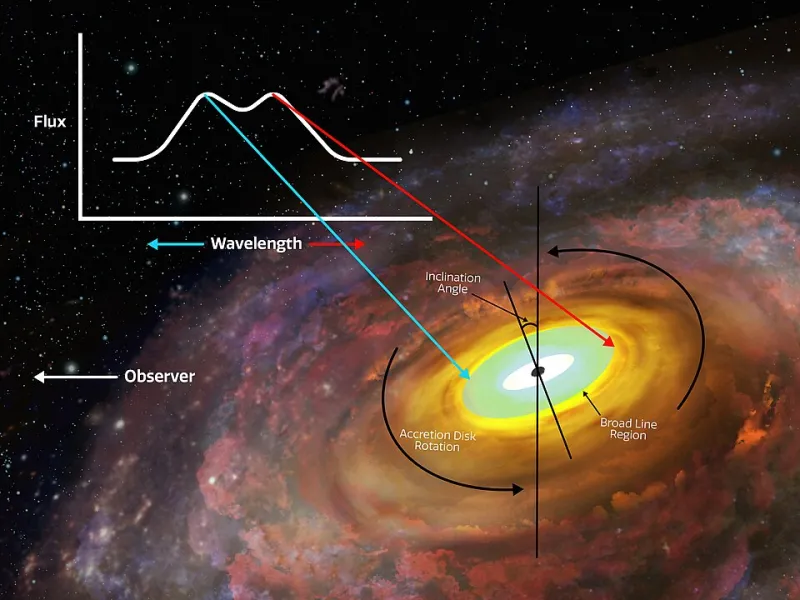
Photo: NOIRLab/NSF/AURA/P. Marenfeld, CC BY 4.0, via Wikimedia Commons
Here's a thought experiment for your next clear night: point a telescope at a quasar billions of light-years away, and you're essentially watching a lighthouse beam sweep past you, over and over, with a rhythm so steady it makes a Swiss watch look sloppy.
But there's no mechanism up there. No gears, no springs, no tiny cosmic janitor winding things. So how does a region of space where physics supposedly breaks down produce some of the most reliable timing in the universe?
The answer involves dragging spacetime itself around like a blender blade — and it's more approachable than you might think.
First, the Lighthouse
Let's start with the obvious part: why quasars pulse at all.
At the heart of every quasar sits a supermassive black hole gorging on infalling gas. That gas doesn't drop straight in — it spirals, forming a superheated accretion disk that glows brighter than entire galaxies. Now, if that disk were perfectly smooth and symmetric, we'd see a steady glow. But it's not. Hot spots, turbulence, and clumps of material orbiting at blistering speeds create brightness variations.
When those variations happen near the disk's inner edge, material can whip around the black hole in a matter of days or even hours. One orbit, one flash. Another orbit, another flash. From Earth, we see a flicker.
In some quasars, a phenomenon called gravitational lensing amplifies this effect. A foreground galaxy acts like a natural magnifying glass, splitting the quasar's image into multiple copies that each brighten and dim on their own schedule. Astronomers have used these ticking images to measure everything from the size of accretion disks to the expansion rate of the universe.
So far, so good — that's orbital mechanics doing its thing. But here's where it gets weird.
Spacetime Has a Spin Cycle
Black holes don't just have mass. They have spin — and when they form from a collapsing star or grow by swallowing material, they conserve angular momentum like a figure skater pulling in her arms. The result: many supermassive black holes rotate at staggering speeds, some approaching a significant fraction of light speed at their edges.
And in 1918, physicists Hans Thirring and Josef Lense predicted something remarkable about rotating massive objects. Space itself, they argued, isn't a passive backdrop — it gets dragged along with the rotation.
This is frame-dragging, and it's exactly what it sounds like. A spinning black hole doesn't just sit in spacetime; it grabs the spacetime around it and whirls it in circles, like a spoon dragging honey around the inside of a jar. Anything orbiting nearby — gas, light, even the fabric of reality — gets carried along for the ride.
NASA's Gravity Probe B mission confirmed a (much milder) version of this effect around Earth back in 2011, measuring our planet's tiny frame-dragging signature with gyroscopes in orbit. Around a rapidly spinning supermassive black hole, the effect isn't subtle. It's dominant.
Why This Makes Quasars Metronome-Like
Frame-dragging does something important to the innermost region of a quasar: it forces everything into alignment.
Normally, you might expect gas to orbit a black hole at all sorts of tilted angles. But near a spinning black hole, frame-dragging twists those orbits toward the black hole's equatorial plane — a phenomenon called the Bardeen-Petterson effect. The inner disk gets flattened and aligned whether it wants to be or not.
That alignment is the secret to the regularity. Instead of a chaotic jumble of orbiting material, the inner disk becomes a well-organized carousel. Hot spots and orbiting clumps sweep past in predictable, repeating patterns. Add in relativistic jets — beams of particles launched along the spin axis, often produced by magnetic fields wound up tight by the rotation — and you've got a system with a strong, stable heartbeat.
The jet, in particular, is a gift to astronomers. Because it's anchored to the black hole's spin axis, it points in one direction for enormous stretches of time. If that beam happens to swing toward Earth (as in blazars, a quasar cousin), we see dramatic, periodic flares as the rotation carries different parts of the jet into our line of sight.
What This Tells Us About Time Itself
Here's the part that should give you chills on your back porch.
Frame-dragging doesn't just move objects. It drags time along with it. Clocks near a spinning black hole tick differently depending on how they move through that swirling spacetime. An observer orbiting with the rotation experiences time differently than one fighting against it.
In other words, when you watch a quasar flicker, you're not just seeing gas go around in circles. You're watching the interplay of matter with a spacetime vortex so extreme that the very definition of "a moment" bends around it.
And yet — and this is the beautiful irony — that same extreme environment produces some of the most regular signals we can observe from billions of light-years away. The universe's most distorted clocks, viewed from a safe distance, become its most useful ones.
Try It Yourself
You don't need a particle accelerator to appreciate any of this. Quasars like 3C 273 in Virgo are within reach of a modest backyard telescope under dark skies. You won't see the flicker in real time — the variations play out over days, months, and years — but organizations like the American Association of Variable Star Observers (AAVSO) welcome amateur monitoring of active galactic nuclei. Your observations, logged over months, genuinely contribute to the study of these cosmic rhythms.
So the next time you catch one of those faint, ancient points of light, remember: you're looking at a spinning engine twisting spacetime into a whirlpool, keeping time not with gears, but with gravity itself.
And unlike your kitchen clock, this one's been running for a few billion years without a single battery change.