The Family Field Trip to the Edge of the Universe: Spotting Quasars With Kids in Your Own Backyard

Photo: Basile Morin, CC BY-SA 4.0, via Wikimedia Commons
Here's a fact you can drop at the dinner table tonight: the dot of light your kid is about to see through a telescope isn't in our galaxy. It isn't in our galactic neighborhood. It's over two billion light-years away — and it still outshines every star you can see with your naked eye combined.
That's a quasar, and hunting one with your family might be the easiest, cheapest, most mind-bending science activity you can do without leaving the driveway.
What Exactly Are You Pointing At?
Start with the basics, but keep it vivid. A quasar is the blazing heart of a distant galaxy — a supermassive black hole that's currently feasting. As matter spirals into the black hole, it heats up to unbelievable temperatures and blasts out more light than the entire Milky Way, all packed into a region smaller than our solar system.
Try this analogy with the kids: imagine a campfire. Now imagine a campfire so bright it could be seen from another continent. A quasar is like that, except the "campfire" is a black hole's dinner table, and you can technically see it from across two billion years of empty space.
The best part for young stargazers? A quasar looks exactly like a faint star. There's something deliciously sneaky about that — the most powerful object you'll ever observe is pretending to be one of the least impressive dots in the eyepiece.
Your Gear Situation Is Better Than You Think
Good news: you don't need much.
- Binoculars (even modest 10x50s from a sporting goods store) can pick up the very brightest quasars from a truly dark site, though it takes patience.
- A small telescope — think 4 to 6 inches, the kind that shows up under plenty of Christmas trees — makes the hunt genuinely doable and way more fun.
- A dark sky. This is the real gear. Streetlights are the enemy. If you're near a city, consider a short drive to a state park or a dark-sky site; many state parks in the US stay open late and host informal astronomy nights.
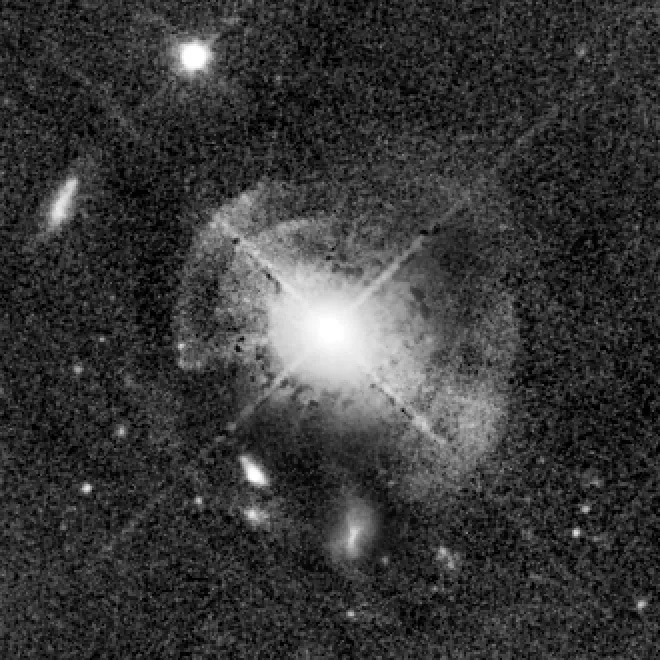
The undisputed champion target is 3C 273 in the constellation Virgo. At magnitude around 12.9, it's the brightest quasar in our sky and the first one ever identified, back in 1963. It's observable from most of the US during spring evenings, and it sits in a patch of sky near some easy-to-find stars, which makes star-hopping to it a great family teamwork exercise.
Other worthy targets include the quasar 3C 48 in Pegasus (fall and winter evenings) and a handful of bright ones in Ursa Major that you can chase on summer nights.
The Quasar Scavenger Hunt
Turn the night into a quest. Print out a free star chart (Sky & Telescope and Stellarium both offer them), highlight your target quasar's location, and build a checklist like this one:
- Find the constellation. Can everyone trace Virgo's rough shape?
- Star-hop. Use bright nearby stars as stepping stones to the quasar's spot.
- The ID test. Quasars look like stars — so how do you know? Trust your chart. If the dot in the eyepiece matches the chart's faint marker, you've got it.
- The light-year math challenge. Have each kid calculate how old the light is. (Answer for 3C 273: about 2.4 billion years. That light started its trip before anything crawled onto land on Earth.)
- The drawing round. Sketch what you see in the eyepiece. Astronomers still do this — it's called a observing log.
- Bonus round: Find one regular star and one galaxy in the same eyepiece session, then debate which is farther away.
Award bragging rights liberally. Whoever spots the quasar first gets to name a fictional black hole for the rest of the night.
Talking Points That Actually Land
A few conversation starters to keep the energy up between eyepiece turns:
- "We're looking at the past." The light hitting your eyeball left before Earth had plants. That's not a metaphor — it's literally old light.
- "There's a monster in the middle." Every big galaxy, including ours, has a supermassive black hole at its center. Quasars are just the ones caught mid-meal.
- "You're doing real science." Amateur astronomers still contribute quasar observations, especially for brightness monitoring. Your kid's sketch isn't just a craft project.
When the Weather Doesn't Cooperate
Clouds happen. Keep a backup plan in your pocket: fire up a free planetarium app like Stellarium on a tablet, simulate the same star-hop indoors, and challenge the kids to plan the hunt for the next clear night. Half the fun of astronomy is the anticipation — and the first clear-sky quasar sighting after a week of clouds will feel earned.
One last tip: bring snacks, blankets, and zero expectations of seeing Hubble-quality images. The goal isn't a pretty picture. It's the moment your kid leans back from the eyepiece and asks, "Wait — that light is how old?"
That question is the whole mission. Everything else is just coordinates.