The Oldest Mail You'll Ever Open: Catching 3C 273's Two-Billion-Year-Old Letter Tonight

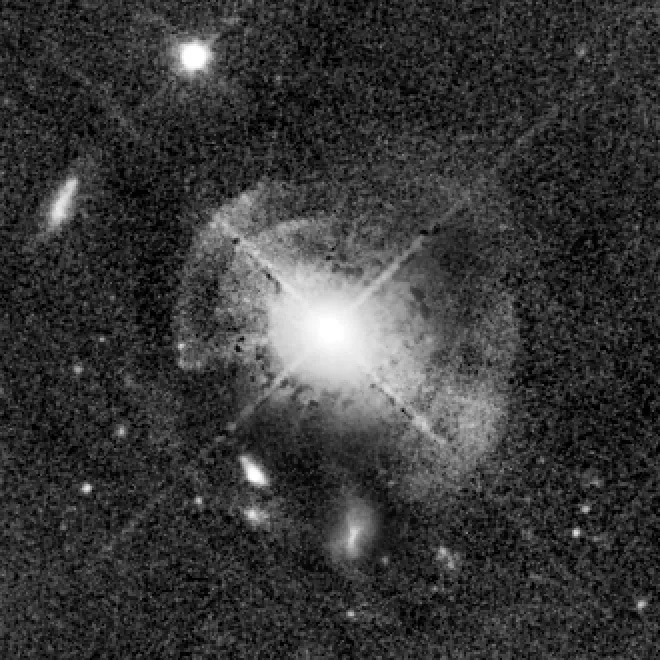
Photo: IMAGE: STScI, Public domain, via Wikimedia Commons
Somewhere in Virgo, right now, a photon is completing a two-billion-year commute. It left home when single-celled life was the height of ambition on Earth. It crossed the void while our planet grew continents, invented sex, killed the dinosaurs, and eventually produced a species that would build a telescope just to catch it. And if you point a modest backyard scope at the right patch of sky on a clear night, that photon's journey ends on your retina.
That's not poetry. That's just how long light takes to get here.
Where the Letter Was Written
Let's rewind to when our traveler started out. The quasar we call 3C 273 — the first one ever identified, back in 1963, and still the brightest one visible to most of the Northern Hemisphere — sits roughly 2.4 billion light-years away. When the light now reaching your eye departed, Earth was in the middle of what geologists call the Proterozoic eon. The atmosphere was barely breathable. Oceans were mostly bacteria and ambition.
A quasar, in case you're new here, is the blazing heart of a galaxy where a supermassive black hole is feeding aggressively. Matter spiraling into the black hole heats up to insane temperatures and outshines every star in the host galaxy combined — sometimes outshining the entire Milky Way a hundred times over. 3C 273 is the closest bright one we've got, which is exactly why it's the perfect target for this exercise. Its light is "merely" a couple of billion years old. Plenty of quasars send us mail that's twelve billion years stale.
The Long, Lonely Trip
For almost all of that journey, our photon did absolutely nothing but travel. Straight line, vacuum, no pit stops. It sailed past galaxies that hadn't formed yet when it left. It crossed regions of space where our solar system didn't exist — the Sun wouldn't switch on for another two billion years after departure.
The only real drama came from expansion. As space itself stretched over the eons, the photon's wavelength stretched with it, a process astronomers call redshift. The light that left 3C 273 as fierce ultraviolet arrives at your eye as a slightly reddened, slightly dimmed version of itself. Think of it as a letter that got a little sun-faded in transit but is still perfectly readable.
Then, in the final leg — a rounding error of eight light-minutes from the Sun to Earth — it threaded the needle past our planet, down through the atmosphere, and into the front lens of a telescope pointed by someone who probably just wanted to see something cool before bed.
Finding It From Your Driveway
Here's the genuinely amazing part: you don't need a research observatory. A 4- or 5-inch telescope under decent skies will show you 3C 273, which shines around magnitude 12.9. It sits in Virgo, near the border with Hydra, not far from the bright star Porrima. Star-hop from Spica using a chart (apps like Stellarium will plot it for you — just search "3C 273") and look for a starry point that doesn't belong.
A few practical tips for the US observing crowd:
- Spring is prime time. Virgo rides high in the evening sky from March through June — great for those post-daylight-saving observing sessions.
- Don't expect fireworks. It looks like a faint blue-white star. The thrill isn't the view; it's the knowledge of what you're looking at.
- Dark skies help but aren't mandatory. From a suburban backyard outside, say, Denver or Atlanta, you'll want a moonless night and patience. Rural locations make it easy.
- Bring a friend and make them guess. Watching someone realize they're seeing a two-billion-year-old object is a reliably great party trick.
What "Time Travel" Actually Means
People throw around the phrase "telescopes are time machines," and it's worth being precise about why. You never see anything as it is — only as it was. Look at the Andromeda Galaxy and you're seeing light 2.5 million years old. Look at 3C 273 and you're seeing the early Proterozoic. Point a big scope at high-redshift quasars and you're reading light from when the universe was a toddler.
The photon landing in your eyepiece tonight is a fossil of an event that ended eons ago. The black hole that launched it may have gone quiet long since — quasars are feeding frenzies, not permanent fixtures, and they burn through their food supply. You're not watching a lighthouse; you're watching the last beam of one, still sweeping across the cosmos.
There's something quietly humbling about that. On the same night you might be grilling burgers or arguing about a baseball game, a message older than animals, older than plants, older than almost everything, arrives at the back of your eye — and you're the first conscious thing it's ever met.
Your Turn
If you've never hunted a quasar, make 3C 273 your first. It's the rare deep-sky object that combines an easy find, a wild backstory, and zero equipment requirements beyond a basic telescope and a clear night. Log it, tell someone, and then look up the quasar catalog for your next target — there are thousands more letters in the cosmic mailbox, some of them twelve billion years old.
All you have to do is stay up late enough to sign for them.