The Sleeping Giant Problem: What Happens When a Dead Galaxy's Black Hole Hits the Switch
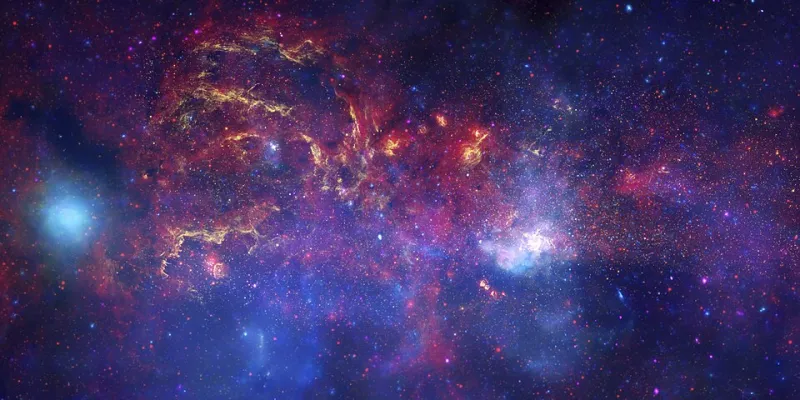
Photo: NASA/JPL-Caltech/ESA/CXC/STScI, Public domain, via Wikimedia Commons
For something with the mass of millions of suns, a supermassive black hole spends an awful lot of time doing absolutely nothing.
That's the default state. A black hole can't eat anything unless matter wanders close enough to get caught in its gravitational whirlpool. In a typical galaxy, the central black hole is surrounded by a starvation diet — stars orbit at a safe distance, gas has mostly settled or been blown out, and the monster slumbers. Astronomers call these "quiescent" nuclei, which is a polite way of saying dormant.
But the universe has a flair for drama. And in the last few years, sky surveys have caught several galaxies mid-transformation — quiet, unremarkable spirals suddenly igniting into quasars, their central engines roaring to life after eons of silence.
Caught in the Act
The key to spotting these wake-up calls is scale. Modern surveys like the Zwicky Transient Facility (ZTF) in Southern California and the Pan-STARRS survey in Hawaii photograph enormous swaths of sky night after night, building a motion picture of the heavens. When a galaxy's core brightens by a factor of ten or a hundred over months or years, algorithms flag it, and astronomers scramble to point bigger telescopes at it.
Some of the best-studied cases are the so-called "changing-look" quasars — objects that were classified as ordinary, line-less galaxies in one era of observations and full-blown quasars in another. SDSS J1011+5442 made headlines when researchers documented its accretion disk essentially shutting down, its brightness dropping off as the black hole's food supply ran dry. The reverse happens too: galaxies written off as boring in older survey data have flared into luminous quasars in newer imaging.
There's also the tantalizing case of AT 2017bgt and similar nuclear transients, where galaxies brightened dramatically in ways that didn't match any known template — possibly a black hole transitioning into a new feeding regime. And the upcoming Vera C. Rubin Observatory in Chile, with its decade-long Legacy Survey of Space and Time, is expected to catch thousands of these ignition events, turning what used to be rare anecdotes into a proper statistical science.
How Do You Wake a Black Hole?
A black hole doesn't have an on switch. What it has is a fuel line.
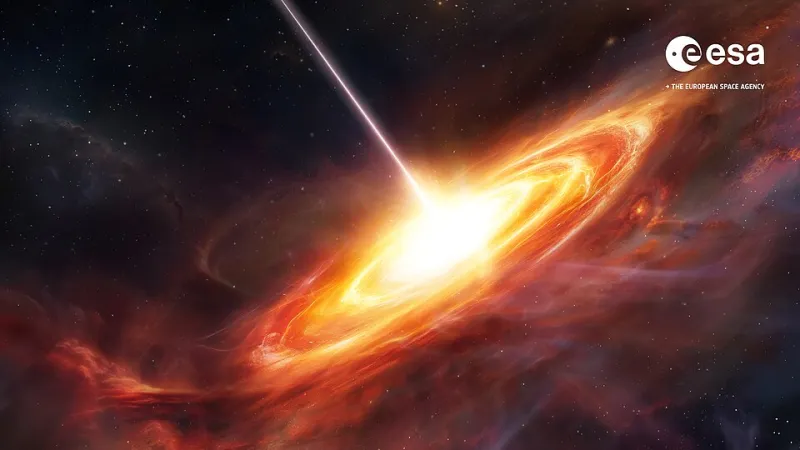
The most common ignition mechanism is a gas supply. A galaxy that swallows a smaller companion — a galactic merger — gets its gas clouds gravitationally stirred like a snow globe. Channels open, and clouds that had been stably orbiting for billions of years suddenly lose angular momentum and spiral inward. When enough gas reaches the innermost regions, it forms a glowing accretion disk, and the quasar ignites.
Sometimes the trigger is smaller and stranger. A wayward star wandering too close can be torn apart in a tidal disruption event, briefly flooding the accretion disk with debris. Some galaxies seem to flicker on and off as clumpy gas clouds drift in and out of the feeding zone — a black hole snacking rather than feasting.
Either way, the physics is the same: infalling matter heats up to extraordinary temperatures as it compresses, radiating so fiercely that a region smaller than our solar system can outshine every star in the host galaxy combined.
What the Galaxy Gets Out of It
Here's the twist — the ignition isn't a one-way street. A newly lit quasar starts punishing its own host.
Radiation pressure and relativistic jets blast gas out of the galaxy's core, sometimes with enough force to eject material clear of the galaxy entirely. That matters, because cold gas is the raw material for new stars. Blow out enough of it, and the galaxy's star formation chokes off — a process astronomers call quenching. Over time, this feedback may be why big elliptical galaxies stopped making stars and settled into quiet retirement.
So a quasar ignition is a bit of a Faustian bargain for the host galaxy: a brief, blazing age of glory, paid for with its future fertility.
So... What About Sgr A*?
Which brings us to home. At the center of the Milky Way sits Sagittarius A*, a black hole of about 4.3 million solar masses, currently sipping at a trickle. It flickers nightly as bits of gas fall in, and it had a modest brightening episode around 2019 that got everyone's attention — but it's nowhere near quasar territory. For Sgr A* to become a quasar, it would need to increase its accretion rate by roughly a hundred-thousandfold.
Could that happen? In theory, yes. The most plausible trigger is a merger with another galaxy — say, the Large Magellanic Cloud, which is on a slow collision course with us, or the Andromeda Galaxy, due to arrive in about 4.5 billion years. A merger of that scale could funnel gas toward the galactic center and, in principle, light the fuse.
Should you worry? Not even a little. Even a full quasar ignition at the galactic center would pose essentially no threat to Earth — we're 26,000 light-years from the core, well outside any danger zone, and the timescales involved are measured in millions of years. The bigger effect would be aesthetic: a brilliant point of light in the constellation Sagittarius, outshining Venus, visible even in light-polluted cities. Something to put on the calendar, if humans are still around to enjoy it.
Watching the Universe Yawn
There's something humbling about quasar ignition events. They remind us that galaxies aren't fixed backdrops — they're living systems with eras and moods, capable of switching personalities on timescales we can actually observe.
For decades, astronomers assumed the quasar phase was a brief chapter early in cosmic history, closed long ago. Now we know the switch still flips. Somewhere out there tonight, a quiet galaxy is brightening, its sleeping giant opening an eye.
With Rubin coming online, we're about to watch it happen — again and again and again.