Billion-Sun Beasts: 5 JWST Finds That Have Cosmologists Rethinking Early Black Holes
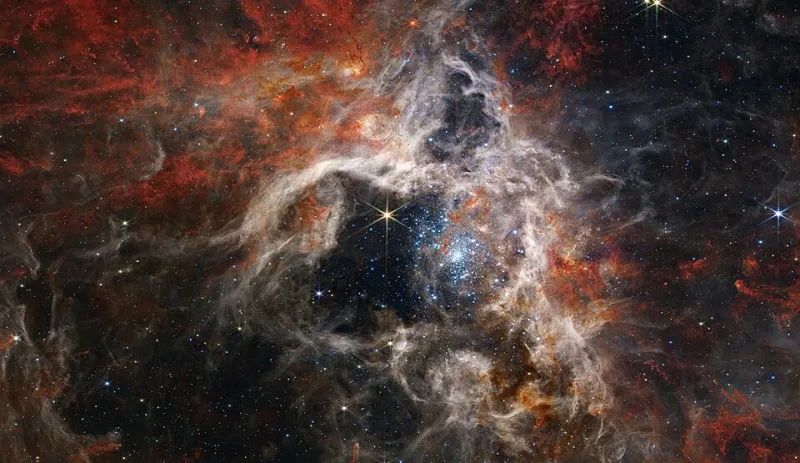
Photo: NASA, ESA, CSA, STScI, Webb ERO Production Team, Public domain, via Wikimedia Commons
Here's a riddle for you: the universe is 13.8 billion years old. So how did black holes weighing as much as billions of suns come to exist when the cosmos was barely a toddler?
The James Webb Space Telescope has turned this puzzle from a nagging problem into a full-blown headache — and honestly, that's when science gets fun. Webb's infrared eyes are built for this era, tuned to catch light stretched by cosmic expansion from the universe's first few hundred million years. What it's finding is forcing cosmologists to redraw their timelines. Let's walk through five of the biggest shake-ups.
1. Supermassive Black Holes That Grew Up Too Fast
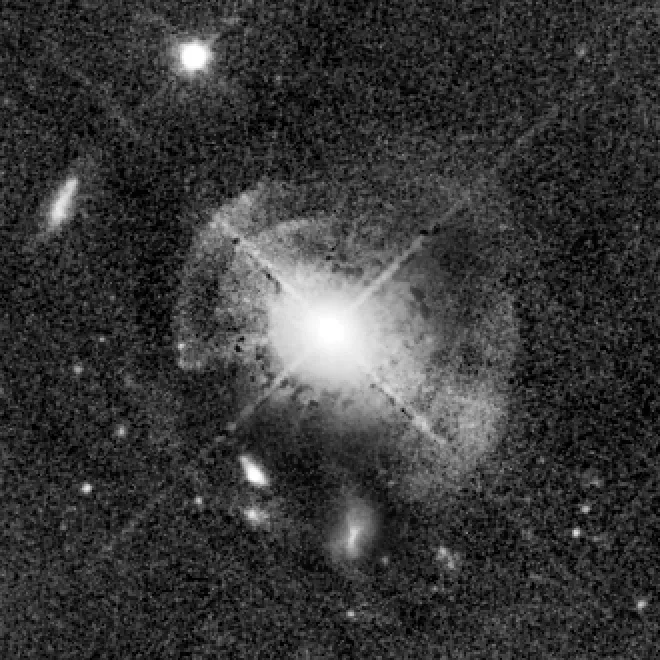
The headline discovery: Webb has confirmed quasars shining when the universe was under 700 million years old, powered by black holes with masses around a billion suns. One famous example, the quasar J0313-1806, tips the scales at roughly 1.6 billion solar masses despite the cosmos being a mere 670 million years young.
Standard growth models say that's impossible — or at least wildly improbable. Even a black hole gobbling matter at the theoretical maximum rate (the Eddington limit) can't pack on that much weight in that little time, starting from a stellar-sized seed. Something's off with our recipe, and Webb keeps adding to the pile of evidence.
2. The Seeds Problem: Where Did They Even Start?
One leading explanation is that early black holes didn't start small. Instead of growing from collapsed stars — "light seeds" a hundred suns or so — they may have formed from the direct collapse of enormous primordial gas clouds, birthing "heavy seeds" tens of thousands of suns in mass right out of the gate.
Webb's surveys are now hunting for these elusive direct-collapse black holes. Finding even a few intermediate-mass examples — thousands to hundreds of thousands of solar masses — would be the smoking gun that nature had a head start built in.
3. Overweight Black Holes in Overweight Galaxies
Webb has spotted several early galaxies where the central black hole is a wildly disproportionate share of the galaxy's total mass. In the nearby universe, black holes typically run about 0.1% of their host galaxy's stellar mass. Some of Webb's high-redshift finds show ratios hundreds of times higher.
That imbalance hints that the first black holes and the first galaxies grew on different schedules — the black holes sprinting while the galaxies jogged. It's a wrinkle that doesn't fit neatly into existing models of co-evolution.
4. Little Red Dots: A Whole New Quasar Population?
Among Webb's strangest finds is a class of compact, crimson objects nicknamed "little red dots." Many appear to harbor actively feeding black holes, but they don't look like classic quasars — no blazing accretion disk signatures, just dense, reddish glow.
Are these dust-shrouded quasars in disguise? A new phase of black hole growth nobody predicted? The debate is ongoing, but if they're genuine accreting black holes, the early universe was hiding a whole population of them we never knew about.
5. Quasars in a Surprisingly Orderly Universe
Perhaps most surprising: Webb's early quasars aren't sitting in chaotic, scrappy protogalaxies. Several reside in galaxies with surprisingly mature, disk-like structure and even evidence of rich chemical makeup — heavier elements cooked up by earlier generations of stars.
Galaxies that fast-tracked their evolution this way complicate our timeline for cosmic history. Structure apparently assembled faster after the Big Bang than many theorists bet on.
So What's the Answer?
Nobody knows yet — and that's the exciting part. The leading contenders are heavy seeds from direct collapse, super-Eddington growth spurts where black holes briefly eat faster than theory allows, or some combination of both. Each new Webb observation helps eliminate possibilities.
What's certain is that the first billion years were a far more action-packed era than we assumed a decade ago. The universe's brightest lighthouses switched on almost immediately, and Webb is just getting started reading their fine print. Stay tuned — this story is being rewritten in real time.