You Owe Your Bones to a Black Hole's Bad Table Manners
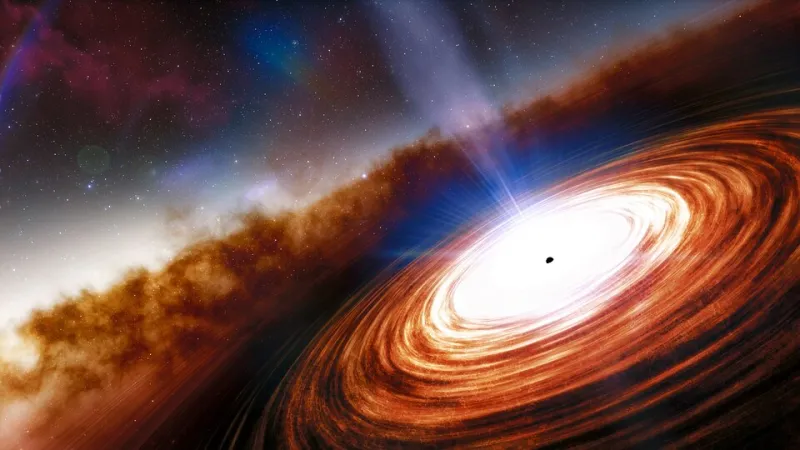
Photo: NOIRLab/NSF/AURA/J. da Silva, CC BY 4.0, via Wikimedia Commons
Here's a fun icebreaker for your next cookout: the calcium that hardened your skeleton was forged inside dying stars, blasted into space, and then — and this is the part nobody mentions — possibly shoveled across the galaxy by the exhaust from a supermassive black hole.
That's not poetic license. It's a genuine line of research, and it reframes quasars from distant curiosities into something closer to cosmic delivery trucks. Let's follow the route your atoms took to get here.
First, the Star Stuff You Already Know About
If you've watched even one Carl Sagan clip, you know the basics. The Big Bang cooked up hydrogen and helium and almost nothing else. Every heavier element — the carbon in your cells, the iron in your blood, the oxygen you're breathing right now — was manufactured later, inside stars.
When massive stars die, they detonate as supernovae and fling those elements outward. Great. Except there's a problem with that story: supernovae alone can't account for everything we see. In many galaxies, the heavy elements are spread out far beyond where the stars that made them ever lived. Something else has been redistributing the goods.
Enter the Quasar, the Galaxy's Roughly-Million-Sun-Watt Furnace
A quasar ignites when a supermassive black hole at a galaxy's center starts feeding aggressively — gobbling gas and shredded stars at a rate that makes the surrounding region outshine every star in the galaxy combined. It's the most efficient light source in the known universe, converting matter to energy with a finesse nuclear fusion can't touch.
But a quasar doesn't swallow everything cleanly. Enormous amounts of infalling material get rejected before it crosses the point of no return, and it doesn't drift away politely. It leaves as a wind — a hurricane of gas moving at thousands of kilometers per second, heated to millions of degrees and loaded with the heavy elements the surrounding stars had been quietly manufacturing for billions of years.
Think of it as the universe's messiest kitchen. The black hole takes a bite, and flour, sugar, and eggs go flying across the room. Except the room is an entire galaxy, and the flour is the raw material of future planets.
The Delivery Route, Step by Step
So how does black hole exhaust become your DNA? Roughly speaking, in four stages:
1. Manufacturing. Stars near the galactic center, living fast and dying young, produce carbon, oxygen, nitrogen, and other essentials. Normally this material would stay put, locked in stellar remnants or drifting through the bulge.
2. Loading. As gas spirals toward the black hole, it passes through a region crowded with these enriched stars and their debris. The inflowing wind picks up the heavy elements like a delivery truck rolling through a warehouse.
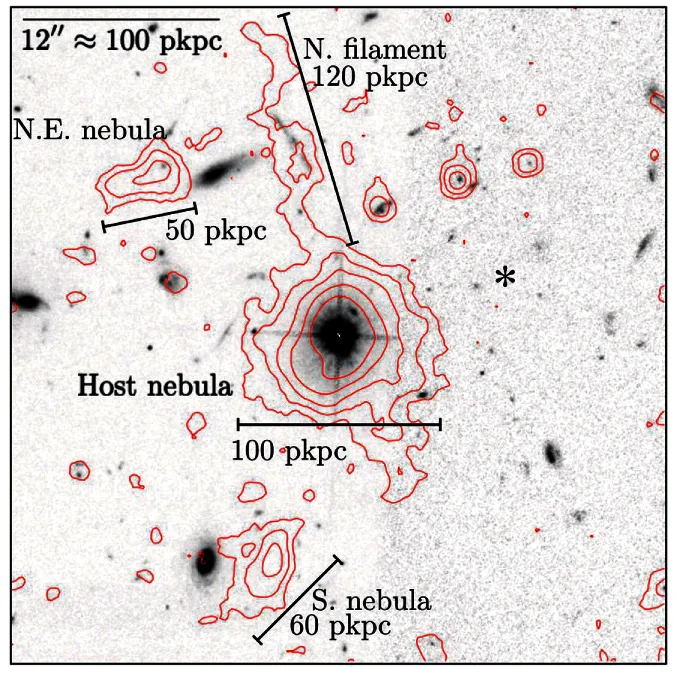
3. Distribution. Quasar winds are powerful enough to blow clear out of the host galaxy's disk, carrying enriched gas into the halo and even beyond. Astronomers have spotted metal-rich gas — in astronomy, "metals" means anything heavier than helium — stretched across hundreds of thousands of light-years around active galaxies.
4. Recycling. That enriched gas eventually cools, falls back in, and collapses into new generations of stars. Some of those stars form planets. At least one of those planets, roughly 13 billion years down the supply chain, has a hardware store in Ohio and a reader scrolling through a space blog.
The Evidence: Fingerprints in the Light
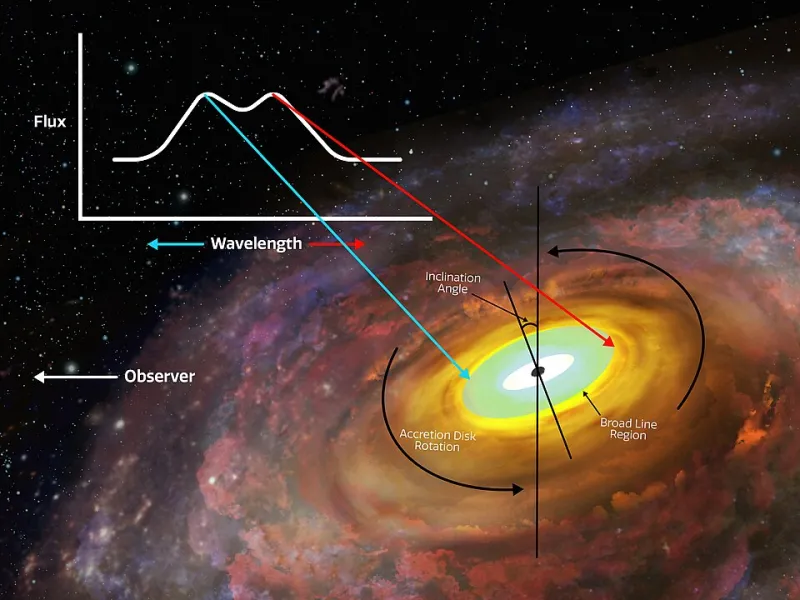
This isn't just a tidy just-so story. When astronomers spread a quasar's light into a spectrum, they see absorption lines — dark gaps where specific elements have stolen specific wavelengths on the way to our telescopes. Those fingerprints show enriched gas streaming away from active galactic centers at exactly the speeds the wind models predict.
There's also a long-standing puzzle this helps solve: galaxies seem to have more heavy elements in their outskirts than their stars alone could have put there. Quasar winds are currently the leading candidate for the missing delivery service.
Why This Should Give You Chills (the Good Kind)
Let's zoom all the way out. Your body is roughly 65% oxygen by mass, plus a healthy dose of carbon, a dash of iron, and trace amounts of nearly everything on the periodic table. All of it was assembled in stars. And a meaningful share of it needed a violent, galaxy-scale redistribution event to get from where it was forged to where your planet formed.
Supernovae did some of that hauling. Quasar winds did the rest — the long-haul freight that supernovae couldn't manage.
So the next time someone tells you that you're made of star stuff, you can one-up them: you're made of star stuff that a supermassive black hole personally flung across the galaxy at a significant fraction of the speed of light before it got around to becoming you.
The monster at the center of the Milky Way, Sagittarius A*, is asleep right now. But billions of years ago, in galaxies far away, its cousins were wide awake, feasting, and unknowingly stocking the shelves for everything that came after.
Including, apparently, you.