Does Your Quasar Chew or Gulp? What Flickering Light Reveals About a Black Hole's Table Manners
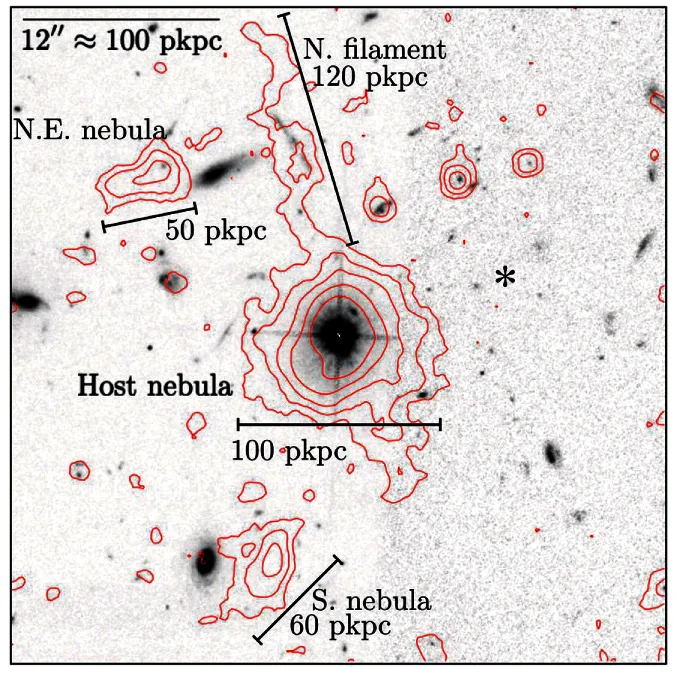
Photo: Sean D. Johnson et al 2022 ApJL 940 L40, CC BY 4.0, via Wikimedia Commons
Some people savor a meal. Others inhale the whole plate and go looking for seconds. It turns out supermassive black holes have the same problem — and unlike your uncle at Thanksgiving, we can actually measure it from billions of light-years away.
The trick is in the flicker. Quasars, the blindingly bright cores of galaxies powered by feeding black holes, don't shine like steady light bulbs. They pulse, dip, and surge in patterns astronomers sometimes compare to a heartbeat. And just like a heartbeat, that rhythm tells you a lot about what's going on inside.
Why a Quasar Flickers at All
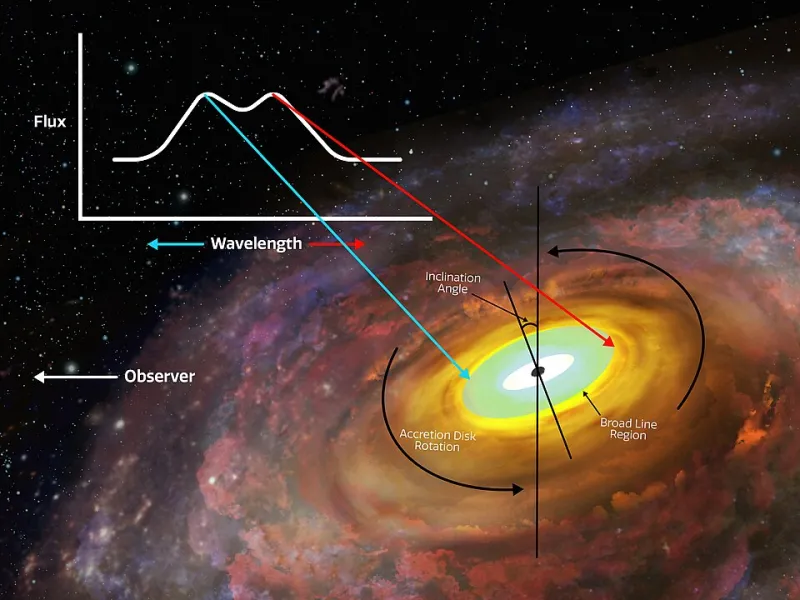
A quasar's light comes from an accretion disk — a flattened whirlpool of gas heated to blistering temperatures as it spirals toward the black hole. Nothing about that process is calm. Magnetic fields tangle, gas clouds tumble in, and the whole disk seethes with turbulence.
When a chunk of gas gets heated or disrupted, the quasar brightens. When things settle, it dims. Multiply that chaos across a disk thousands of times wider than our solar system, and you get a light curve that looks like a seismograph during an earthquake.
Here's the key insight: bigger disks are slower to flicker. If one side of a huge disk brightens, light from the far side takes longer to reach us, smoothing out the variations — like how a big stadium wave looks gradual while a flash mob moves instantly. Small, tightly wound disks can change their brightness in days. Whoppers take months or years.
So the flicker rate is basically a ruler. Measure the rhythm, and you've measured the disk.
Grazers, Bingers, and the Cosmic Food Spectrum
Different quasars eat very differently, and their light curves give them away.
The grazers feed on a steady drizzle of gas — think of a cow in a pasture, nibbling all day. Their accretion disks are stable, and their brightness wanders gently over months. Many of the classic, well-studied quasars fall into this camp.
The bingers get a sudden delivery — maybe a star torn apart, or a gas cloud knocked loose by a galaxy collision — and they gorge. Their brightness can swing dramatically in weeks. In extreme cases, a quasar can flare up thousands of times brighter than its galaxy's normal output and then fade away entirely, a phenomenon astronomers have caught red-handed with modern surveys.
The picky eaters barely eat at all. Their black holes sit in a low-power state, flickering weakly like a candle in a drafty room. Some objects have been observed switching between these modes — 'changing-look' quasars that seem to swap personalities between observing runs, baffling scientists who expected these transitions to take millions of years rather than a human lifetime.
The meal size matters as much as the frequency. A black hole swallowing a slow, steady stream of gas produces a different flicker signature than one demolishing a star in a single sitting. Over time, patterns in the light curve can hint at what's on the menu.
Reading the Rhythm From 10 Billion Light-Years Away
How do you take a black hole's pulse? The same way a doctor does: watch, wait, and record.
Astronomers point telescopes at the same quasar night after night, year after year, building a light curve — a graph of brightness over time. Then they run the data through statistical tools that extract the underlying 'timescale' of the flicker. That timescale, scaled by the quasar's known mass and distance, reveals the disk's size.
There's an added bonus. Sometimes a galaxy between us and the quasar acts like a gravitational lens, splitting the quasar's light into multiple images. Because each image takes a slightly different path, the flickers arrive at different times. Measuring that delay gives an extraordinarily precise distance measurement — and it's helped nail down cosmic expansion rates, feeding an ongoing (and occasionally feisty) debate in cosmology about how fast the universe is growing.
Not bad for watching something blink.
You Can Take the Pulse Too
Here's the part backyard astronomers love: quasar monitoring is one of the few areas of cutting-edge science where amateur gear genuinely contributes.
Quasars are faint — most sit between magnitude 12 and 16 — but that's within reach of an 8- or 10-inch telescope under dark skies, especially with a CCD or CMOS camera. Organizations like the AAVSO (American Association of Variable Star Observers) coordinate long-term monitoring of hundreds of quasars, and their database feeds directly into professional research. Programs like the Sloan Digital Sky Survey and time-domain surveys such as ZTF handle the wide net, but dedicated amateurs provide the dense, long-baseline coverage big surveys can't always afford.
Getting started is simpler than you'd think:
- Pick a target from the AAVSO's list of monitored blazars and quasars — many are well-placed from US backyards in the evening sky depending on the season.
- Take calibrated images on as many nights as you can, even if conditions aren't perfect.
- Submit your brightness measurements to the AAVSO database.
No single night tells us much. But string together hundreds of nights from dozens of observers, and you get the kind of years-long light curve that reveals a black hole's dining habits. Somewhere out there, a monster the size of our solar system is mid-meal — and with a telescope and a little patience, you can listen to it chew.