Star Signs and Interstate Signs: A Roadside Guide to America's Quasar Landmarks
Every American road trip has its rituals. You stop at the giant dinosaur statue in South Dakota. You photograph the world's largest pecan. You pull over for views that make you say "huh" out loud.
Tonight, we're proposing a different kind of itinerary — one where the attractions aren't on the roadside but a few billion light-years above it. Think of this as your AAA TripTik for the universe's most extreme landmarks: quasars you can actually point to from your driveway, no observatory required.
What Counts as a Cosmic Landmark?
A quick refresher before we hit the road. A quasar is the blazing core of a distant galaxy, powered by a supermassive black hole gorging on gas so violently that the region around it can outshine every star in its host galaxy combined. Because they're so absurdly bright, we can spot them across most of the observable universe.
The catch: none of them are visible to the naked eye. Every stop on this tour requires at least binoculars, and most want a modest telescope. But here's the roadside-attraction magic — you don't need much. If you can find a bright star with a star chart, you can find these.
Stop One: 3C 273 — The Grand Canyon of Quasars
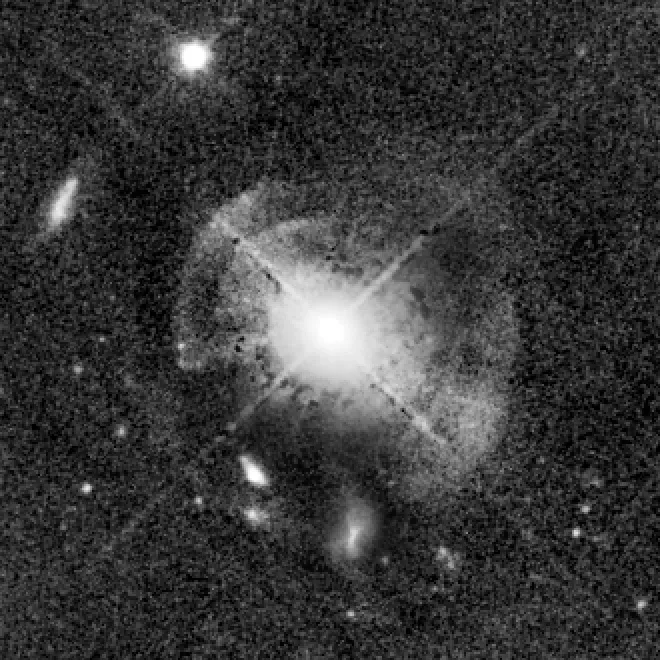
If the quasar tour has a must-see headliner, it's 3C 273 in Virgo. This was the first quasar ever identified, back in 1963, when astronomer Maarten Schmidt realized the strange light coming from this "star" was shifted so far red that it had to be roughly two billion light-years away. Nothing this luminous should exist. Astronomers spent years scratching their heads.
Where to point: 3C 273 sits in Virgo, at roughly RA 12h 29m, Dec +02° 03'. The trick is that Virgo is a spring constellation from the US, so your best viewing window runs from late winter through early summer. March and April evenings are prime time — Virgo climbs high in the south after dark.
Difficulty: Moderate. At around magnitude 12.9, you'll want a 6-inch or larger telescope and a dark site — think rural Pennsylvania, the Texas Hill Country, or just about anywhere away from a city's glow. Star-hop from Eta Virginis using a detailed chart or a GoTo mount, and look for an unremarkable "star" that has no business being 2 billion light-years away.
That's the payoff, by the way. The Grand Canyon is impressive because of scale; 3C 273 is impressive because of what your brain does when it processes that this faint dot is outshining a trillion stars.
Stop Two: OJ 287 — The Blazar With a Punch Card
Our second stop plays by weirder rules. OJ 287, in Cancer, isn't just a quasar — it's a blazar, a quasar aimed at us like a flashlight pointed straight at your eyeball. It also hosts what scientists suspect is a pair of orbiting black holes, and roughly every 12 years it throws a tantrum: dramatic outbursts that have made it one of the most watched objects in the sky.
Where to point: Cancer, around RA 08h 55m, Dec +20° 06'. That makes winter your season — Cancer rides high on cold January and February nights, which is fitting, because there's something right about hunting a violent double-black-hole system while your breath fogs in the eyepiece.
Difficulty: Variable, and that's the fun part. OJ 287 flickers between magnitude 12 and 15 depending on its mood. During an outburst, a backyard scope catches it easily; during quiet stretches, it's a challenge even for bigger instruments. Check the American Association of Variable Star Observers (AAVSO) for current brightness estimates before you plan your night.
Stop Three: The Messier 77 Bonus Attraction
Every good road trip has a bonus stop. Messier 77 in Cetus — the first-discovered Seyfert galaxy — is a quasar's little sibling: an active galactic nucleus that's closer and gentler. At magnitude 9 or so, it's findable in binoculars from dark skies and a snap in any telescope. Fall is your window, when Cetus swims through the evening sky from October through December.
It won't knock your socks off visually — it looks like a faint smudge. But you're looking at the same engine, just running at a lower gear. Consider it the quirky small-town museum stop between the big landmarks.
Packing Your Cosmic Road Kit
Unlike the interstate version of this trip, you won't need gas money — but you do need:
- A telescope with aperture. Six inches minimum for the main attractions; eight or more if you want comfort.
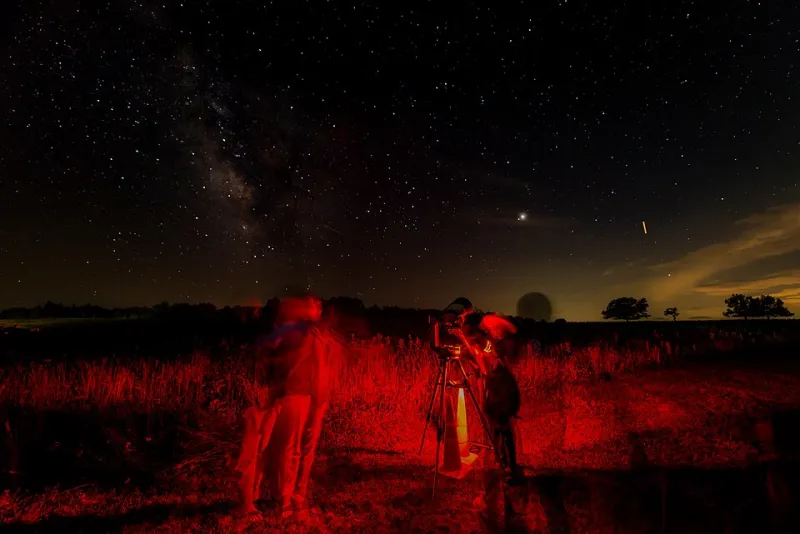
- A red flashlight to preserve your night vision while reading charts.
- A planisphere or astronomy app with accurate coordinates — quasars don't announce themselves.
- Patience and dark skies. Check light-pollution maps and pick a moonless night. The Moon is the highway billboard glare of stargazing.
Why Bother Collecting These?
Here's the thing about roadside attractions: half the joy is the story you bring home. "I saw the world's largest rocking chair" becomes "I watched light that left its home before Earth had oxygen land on my retina."
Quasars are the ultimate version of that story. Every one you check off is a supermassive black hole mid-feast, seen from so far away and so long ago that you're effectively time traveling. 3C 273's light started its journey before animals walked on land.
So mark your calendar for the season, charge your phone, grab the chart — and start your collection. The universe's gift shop is open every clear night, and everything's free.