Your Morning Coffee Is a Black Hole Leftover: The Unlikely Recycling Program Behind Every Atom You Own
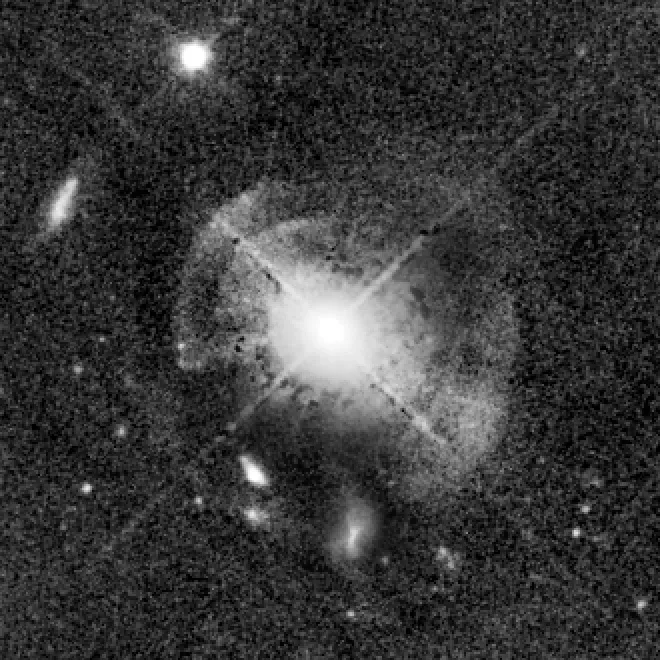
Photo: NASA, ESA, and G. Canalizo (University of California, Riverside), Public domain, via Wikimedia Commons
Pour yourself a cup of coffee and take a sip. Congratulations: you just drank a little piece of a dead quasar.
That's not a metaphor, and it's not the kind of cosmic hand-waving you usually get in "we are all stardust" think pieces. The iron swirling in your bloodstream, the calcium in your bones, the oxygen in that steam rising off your mug — a surprising share of those atoms got processed, blasted, and redistributed by the most misunderstood objects in the universe. Supermassive black holes aren't just cosmic garbage disposals. They're the universe's most aggressive recycling plants.
First, the Chemistry Problem the Big Bang Couldn't Solve
Here's an inconvenient fact about the universe's origin story: the Big Bang was a terrible cook. It produced hydrogen, helium, and trace amounts of lithium — and essentially nothing else. No carbon. No oxygen. No iron. Definitely no caffeine.
Everything on the periodic table past helium had to be built later, inside stars. Stellar furnaces forged carbon and oxygen in their cores, and when massive stars died in supernova explosions, they seeded space with heavier elements still — silicon, magnesium, and the iron that makes your blood worth carrying around.
So far, so familiar. This is the standard "stardust" speech. But it skips a crucial problem: forged atoms don't do anyone any good sitting inside a galaxy's core, locked in gas that never got the memo to become planets or people. Something had to move that material around. Something with serious muscle.
Enter the Quasar: A Furnace With a Bad Attitude
When a supermassive black hole feeds aggressively, the infalling matter doesn't just vanish quietly down the drain. It heats up to extraordinary temperatures and blazes brighter than entire galaxies — that's a quasar, and it's the reason this website exists.
But here's the part that rarely makes the highlight reel: quasars don't just emit light. They exhale. Enormous winds of gas, driven by radiation pressure from the accretion disk, slam outward at thousands of miles per second. Some of these outflows — sometimes called ultraviolet winds or ultrafast outflows in the literature — carry enriched material, atoms already cooked by generations of stars, and fling it far beyond the galactic center.
Think of a quasar as a pressure cooker with a stuck lid. All that energy has to go somewhere, and the relief valve points outward, into the galaxy. Astronomers have caught these winds in action, tracing oxygen and iron ions racing out of galactic cores and enriching the surrounding gas — sometimes even blowing material clean out of the galaxy entirely.
That outflow is the delivery service. Without it, a galaxy's heavy elements would stay concentrated near the middle, and the outer disk — where star formation quietly churns out suns like ours — would stay chemically impoverished. Instead, the black hole's tantrum fertilized the neighborhood.
The Milky Way's Own Ghost Kitchen
We have the receipts for this, too, and they're local. Sagittarius A*, the supermassive black hole at the center of our own galaxy, is napping today. But evidence suggests it wasn't always so lazy — a few million years ago, it likely hosted an active phase, and traces of that activity are still written into the gas above the galactic center.
Look up on a truly dark night, far from city lights, and you can spot the Fermi Bubbles — two enormous lobes of hot gas extending tens of thousands of light-years above and below the Milky Way's disk, discovered by NASA's Fermi Gamma-ray Space Telescope in 2010. They're widely interpreted as the fingerprint of a past outburst from our own central black hole. Our galaxy's core had its quasar moment, and the exhaust plume is still glowing.
Every atom in your body arrived in the galactic outskirts — the quiet suburbs where the Sun formed — after billions of years of supernovae, stellar winds, and, yes, black hole outflows churning and distributing the goods.
So How Much of You Is Black Hole-Adjacent?
Honest answer: it's complicated, and astrophysicists actively debate the exact accounting. Supernovae deserve most of the credit for forging heavy elements, and mixing mechanisms like galactic fountains and galaxy mergers do plenty of distribution work too. Quasar winds are one player in a crowded ensemble — but a distinctive one, because they're the only mechanism that can blast enriched gas on galaxy-wide scales in a single, violent event.
The better framing isn't "black holes made you." It's that black holes helped renovate the house you live in. They redistributed the building materials, ventilated the galactic core, and in some cases regulated star formation itself — quasar winds can heat gas enough to slow the birth of new stars, shaping which parts of a galaxy even get to have a next generation.
The Vacuum Cleaner That Cleans in Reverse
There's a pleasing irony here. Supermassive black holes earned their reputation as the universe's ultimate destroyers — objects so ruthless not even light escapes. Yet the evidence keeps piling up that they're also among the universe's great enablers. They scatter the ingredients of worlds. They may help regulate how galaxies grow. And in doing so, they set the table for things like planets, oceans, and, eventually, a species that figured out how to brew espresso.
So the next time someone at a party calls a black hole a cosmic vacuum cleaner, you've got a comeback: vacuum cleaners that also empty their bags back into the room. The universe doesn't hoard its elements. It recycles them — loudly, violently, and with a detour through the brightest lights in the cosmos.
Your coffee never stood a chance of being anything other than quasar-adjacent. Drink up.