The Moon Pulls a Black Hole Move: Why America's Next Total Eclipse Is a Dress Rehearsal for Quasar Hunters
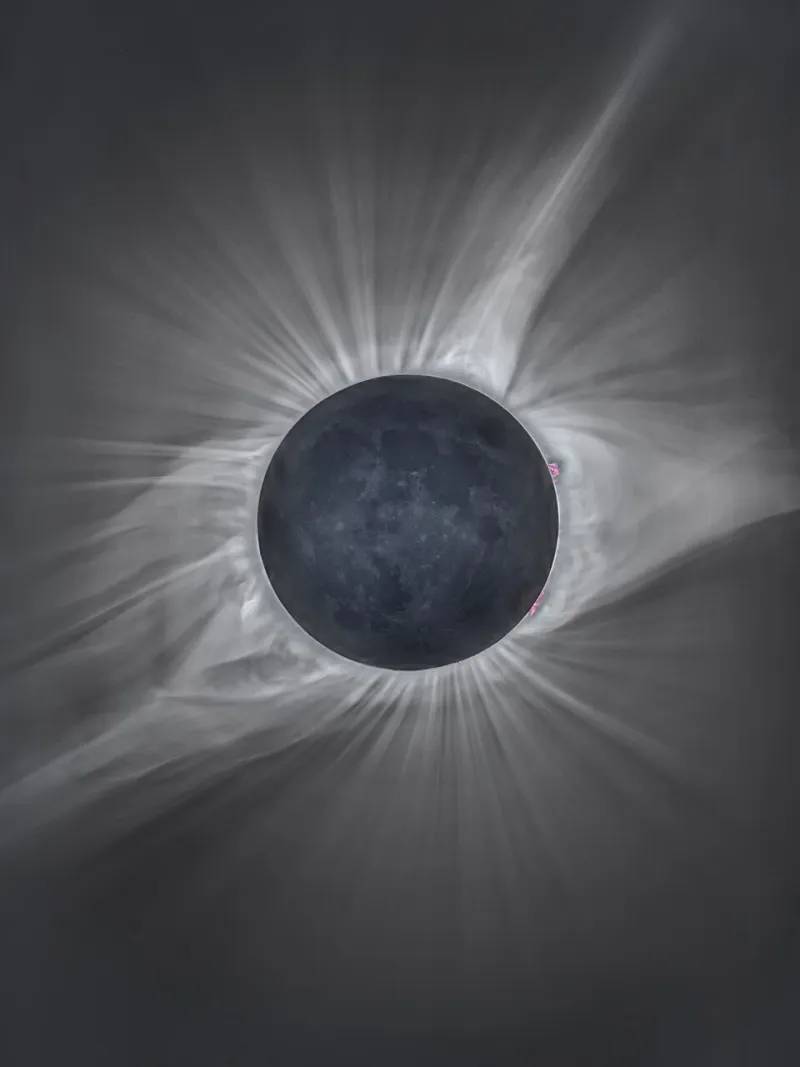
Photo: Michael S Adler, CC BY-SA 4.0, via Wikimedia Commons
We spend a lot of time at Quasarborn talking about the brightest things in the universe — objects so luminous they make entire galaxies look like night-lights. And yet, ask any veteran stargazer what sky event actually made their jaw hit the floor, and the answer is almost never a quasar. It's a total solar eclipse.
There's a delicious irony there. The most dramatic sight in Earth's sky happens when something blocks the light, not when something blasts it out. The Moon, a chunk of rock 2,000 miles wide, temporarily pulls off the ultimate cosmic photobomb. For a couple of minutes, daytime collapses into twilight, temperatures drop, planets pop out, and a shimmering corona hangs in the sky like a hole punched through reality.
If that sounds a little like staring down an event horizon — well, you're not wrong. And that's exactly why every quasar hunter in America should treat totality as a practice run.
The Ultimate Low-Light Test
Here's the thing about spotting a quasar from your backyard: you're not looking for a bright object. You're looking for the absence of brightness — an incredibly faint smudge of light that left its home billions of years before dinosaurs existed. Finding one requires dark adaptation, patience, knowing exactly where to point, and the discipline to not panic when you see nothing at first.
A total eclipse demands the same skill set, compressed into a few chaotic minutes.
During the partial phases, your eyes are hammered by sunlight. Then totality hits, and suddenly you're trying to pick out faint features — the corona's streamers, pink prominences at the solar limb, Mercury lurking nearby — in what amounts to a deep-sky observing session with a countdown clock. If you can keep your cool and your plan together under that kind of pressure, a long night chasing 3C 273 in Virgo will feel downright relaxing.
So train for it. Months before the eclipse, practice the routine: locate a faint target, note the time, describe what you see, move to the next objective. During totality, you'll have roughly two to four minutes to execute a similar list — corona structure, planet count, horizon glow in every direction, temperature change. Astronomers call this a "running commentary," and it's the same muscle memory you'll use logging observations of variable quasars.
Where the Shadow Falls
The Moon's shadow is small — only about 100 to 115 miles wide — so geography matters enormously. Here's the broad stroke of the path as it crosses the country, west to east:
- Texas: The shadow makes landfall along the Mexican border and sweeps up through San Antonio, Austin, and Dallas-Fort Worth. Big advantage: April climatology in the Lone Star State historically offers some of the best odds of clear skies on the entire path.
- Oklahoma and Arkansas: The band clips southeastern Oklahoma before rolling over Little Rock and the Ouachita Mountains — gorgeous country for a dark-sky road trip.
- Missouri, Illinois, Kentucky: The shadow slides over the Missouri Bootheel and cuts across southern Illinois, which — fun fact — was the crossroads of the 2017 and 2024 eclipse paths. Carbondale became "eclipse crossroads of America" for a reason.
- Indiana and Ohio: Indianapolis sits near the northern edge of totality, while Dayton and Cleveland get the full show.
- Pennsylvania, New York, and New England: Erie, Buffalo, Rochester, and Burlington, Vermont all fall inside the band, with the shadow exiting through northern Maine.
If you live outside the path, don't despair — a 95% partial eclipse is still striking. But it is not the same event. The difference between 99% and totality is the difference between hearing about the Grand Canyon and standing at the rim. The corona only appears when the last sliver of photosphere is covered.
The Physics Hiding in Plain Sight
Part of what makes eclipses such great practice for astronomy is that they're a physics lesson you can watch unfold. Total solar eclipses only happen because of a coincidence so absurd it feels like a prank: the Sun is about 400 times wider than the Moon, but it's also about 400 times farther away. From Earth's surface, they appear almost exactly the same size.
That coincidence won't last. The Moon is drifting away from us at about 1.5 inches per year — the same rate your fingernails grow. In roughly 600 million years, total solar eclipses will be history. Every eclipse you catch is a limited-time offer.
And then there's the corona itself. That wispy white halo isn't a camera artifact — it's the Sun's outer atmosphere, heated to over a million degrees by magnetic processes scientists are still untangling. It's normally completely invisible, washed out by the solar disk. Only when the Moon plays occluding shield can you see it with your naked eye. In a very real sense, an eclipse lets you observe the Sun's atmosphere the same way a backyard telescope lets you observe a quasar's host galaxy: by blocking the glare and looking for what's left.
Bring the Family Along
If you've read our guide to spotting quasars with kids, you know we're big believers in turning sky events into family traditions. An eclipse is the perfect on-ramp. No telescope required, no faint smudges to squint at — just pinhole projectors made from cereal boxes, colanders casting crescent shadows on the driveway, and a countdown to the main event.
Have the kids watch for the shadow bands rippling across light-colored pavement just before totality, and listen for birds going quiet as darkness falls. Those sensory details are what convert a curious kid into a lifelong astronomer. Some of them will eventually be the ones pointing telescopes at objects 10 billion light-years away.
Darkness as a Teacher
Quasars taught us that the universe's brightest beacons are powered by the darkest objects imaginable — matter spiraling into black holes. Eclipses teach a gentler version of the same lesson: sometimes the most spectacular thing the sky can do is take the light away for a moment.
So when the shadow comes to your corner of America, treat it like the professionals do. Make a plan. Practice your observing routine. And when totality hits and the corona blooms overhead, take two seconds to just look — then get back to your checklist. The quasars will still be there tonight, and after this rehearsal, you'll be ready for them.