Driveway Astronomers Are Texting Black Holes: Inside the Backyard Network That Keeps Tabs on Quasars
The Brightest Things in the Universe Have a Paper Trail
When a blazar flares, it can double in brightness in a matter of hours. The professional observatories that study these objects — supermassive black holes with their jets pointed straight at us — can't watch them every single night. They've got telescope time schedules, grant deadlines, and weather. So who fills in the gaps?
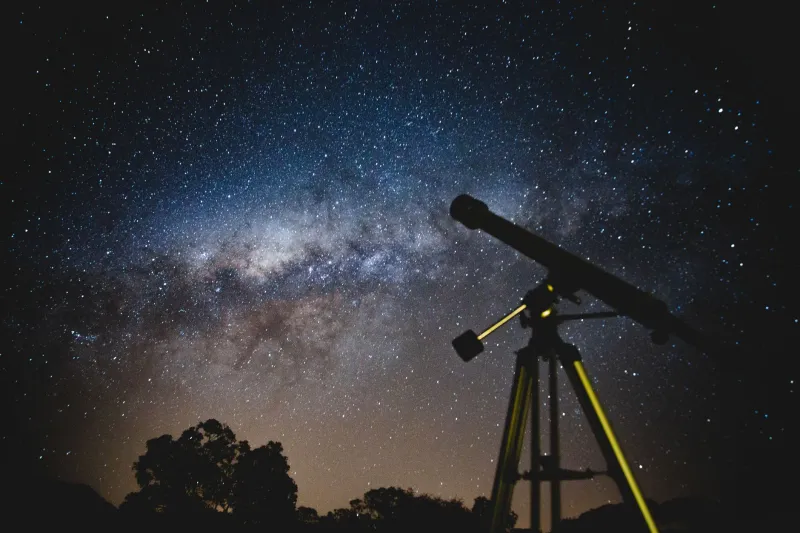
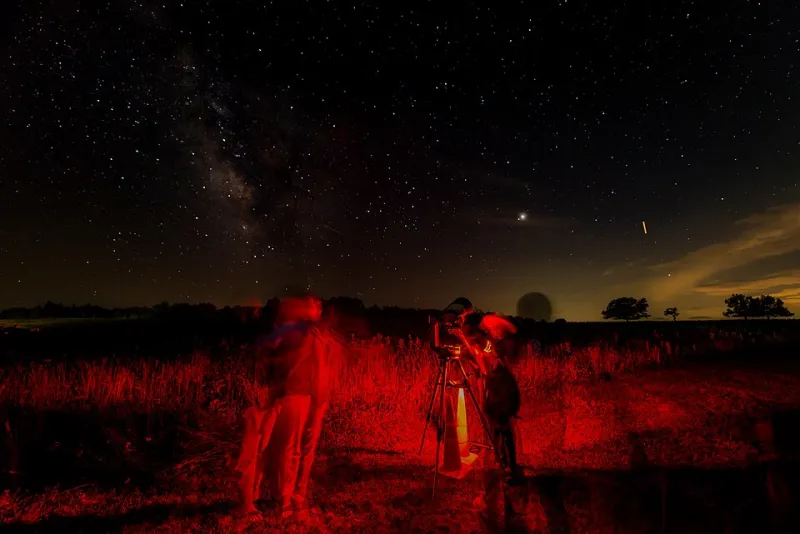
Increasingly, it's people like Mike from Ohio, a retired high school science teacher who logs brightness measurements of blazar BL Lacertae from his backyard with an 8-inch Schmidt-Cassegrain telescope and a used CCD camera. His observations get uploaded to the American Association of Variable Star Observers (AAVSO), where they sit alongside data from professionals — and sometimes get cited in published papers.
"Nobody believes me at parties," he laughs. "I tell them I'm monitoring a black hole and they think I'm doing some kind of sci-fi roleplay." He is not. He is doing real science, and so are dozens of others like him across the country.
What Exactly Are They Watching?
Quasars and blazars are the same basic beast: supermassive black holes feeding on galactic gas, with the infalling material heating up until it blazes brighter than the entire host galaxy. What makes blazars special is orientation. Their jets — beams of particles launched at nearly light speed — happen to point in our direction, like a lighthouse aimed at your front porch.
That beam makes them wildly variable. One night a blazar is a faint smudge; a week later it might be bright enough to spot in a modest telescope. Tracking those ups and downs tells researchers about the physics of the jet itself: how fast particles move, where energy gets released, and what happens when the black hole's meal gets choppy.
The catch? You need near-continuous coverage. Which is where the driveway network comes in.
The AAVSO: A 110-Year-Old Group Chat
The AAVSO has been crowdsourcing variable star observations since 1911, long before "citizen science" was a buzzword. Today its instrument database includes active galactic nuclei — the umbrella term for quasars and blazars — and professional campaigns increasingly lean on amateur measurements.
When a space-based observatory like Fermi detects a gamma-ray flare from a blazar, researchers often issue a call for optical follow-up. Amateurs respond. Their job is simple but crucial: measure the object's brightness every clear night using standardized methods, so the data from a backyard in Arizona can be compared with one in Georgia.
The result is a light curve — a graph of brightness over time — that no single observatory could ever produce alone. Some blazars have now been monitored this way for decades, giving scientists an unbroken record of a black hole's feeding habits.
How to Become a Black Hole Watcher Yourself
Here's the good news: the barrier to entry is lower than you'd think.
1. Start with the gear you have. A telescope with a 6-inch aperture or larger and a basic astronomy camera (or even a DSLR) is enough for bright blazars like BL Lac or 3C 273, the first quasar ever identified. You don't need a mount that costs as much as a used car — just something that tracks the sky.
2. Learn differential photometry. This is the core skill. You measure your target's brightness relative to nearby stars of known brightness. Free software like VStar or AstroImageJ walks you through it, and the AAVSO's online courses cover the whole workflow in a few evenings.
3. Pick a target and stick with it. The AAVSO maintains a list of variable objects needing observation, including several blazars. Consistency matters more than sophistication — a hundred nights of decent measurements beat one perfect night.
4. Upload and become part of the record. Once you submit observations, your data joins a century-old archive. When a researcher at a university downloads a light curve that includes your numbers, you're officially a co-contributor to human knowledge about a black hole billions of light-years away.
Why It Matters More Than Ever
Time-domain astronomy — watching things change — is the hottest game in astrophysics right now. Surveys like the Rubin Observatory's upcoming all-sky movie will flag thousands of changing quasars, but confirming and characterizing them still requires follow-up. Human eyeballs and backyard CCDs remain part of that pipeline.
There's also something quietly profound about the whole arrangement. The light hitting Mike's sensor left its source when the universe was young. It traveled for billions of years, crossed the entire cosmos, and landed in a suburban backyard in the Midwest, where a retired teacher turned it into a row of numbers.
"People ask why I do it," he says. "It's one thing to read that we're connected to the universe. It's another thing to have a spreadsheet that proves it."
The black holes aren't going anywhere. Neither, it turns out, are the people watching them from their driveways — one clear night at a time.