Should You Worry About a Quasar Stray Shot? A Friendly Risk Assessment
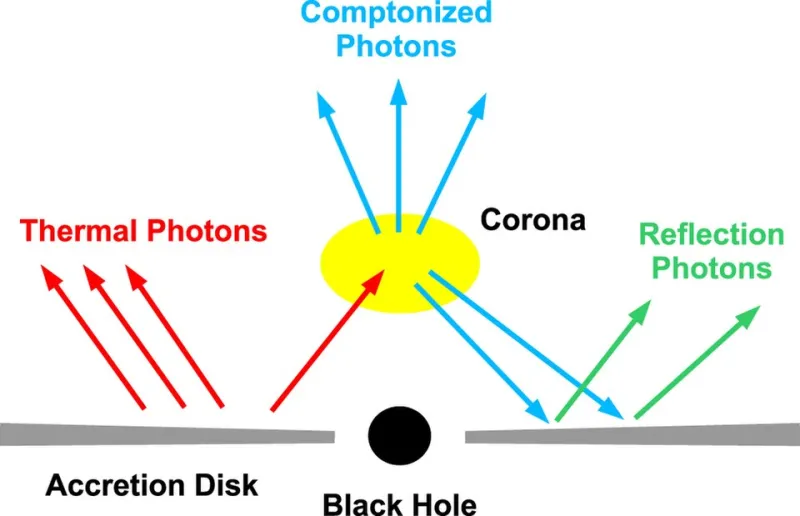
Photo: Cosimo Bambi, CC BY 4.0, via Wikimedia Commons
Every so often, a reader emails us a version of the same anxious question: quasars are the brightest, most violent things in the universe — could one ever point its beam at Earth? It's a fair question. We're talking about jets that punch out of galaxies and stretch for hundreds of thousands of light-years, carrying more energy than our Sun will emit in its entire lifetime.
So let's do what any sensible American would do before panicking: run a proper risk assessment.
Know Your Monster: What Quasar Jets Actually Are
Around some feeding supermassive black holes, infalling gas and twisted magnetic fields conspire to launch a fraction of the material back out at absurd speeds — we're talking 99%+ of the speed of light — in two tightly focused beams fired from the poles of the accretion disk.
These jets are terrifying up close and magnificent from far away. If one of them happens to point almost directly at us, relativistic beaming amplifies its brightness enormously, and we call the object a blazar. That's not a different beast, just a quasar caught facing us.
Here's the key physics: jets are narrow. The high-energy core of a jet is roughly a cone a few degrees wide. Space, meanwhile, is overwhelmingly not a few degrees wide. That geometry does most of the safety work for us right there. But let's not hand-wave — let's check the actual candidates.
Scanning the Neighborhood: Where Are the Closest AGN?
First, the good news about right now: there is no classical quasar anywhere near us. The nearest genuinely active galactic nuclei are millions of light-years away, and the closest things we have to candidates are modest at best.
- Sagittarius A, our own galactic center's black hole*, is in a deep slumber, sipping barely anything. Even if it suddenly binged, its jets (which it does faintly produce) point perpendicular to the plane where we live, and it's 26,000 light-years away besides.
- Centaurus A, the nearest actively feeding galaxy at about 12 million light-years, does launch impressive jets — aimed nowhere near us, and far too distant for its output to meaningfully irradiate Earth even in the worst case.
- The nearest true quasars are hundreds of millions of light-years out. At those distances, their energy spreads across a sphere so vast that even a direct jet hit would be a footnote in our atmosphere's ledger, not an extinction event.
The nearest potentially jet-bearing AGN in any realistic future scenario is the Andromeda Galaxy's central black hole — and that brings us to the actual plotline worth following.
The Real Long-Term Story: The Milky Way–Andromeda Merger
In roughly 4 to 5 billion years, the Milky Way and Andromeda are expected to merge. During the collision, gas will be funneled toward both central black holes — the exact feeding mechanism we cover in our merger explainers. There's a genuine chance that our galactic center's black hole, or Andromeda's, briefly ignites as an active galactic nucleus during that era.
Should anyone in the far-future solar system care? Probably not much. Even an active phase would most likely pump energy into the surrounding galaxy gradually, and the famous scenario where the Sun gets flung onto a different orbit around the merged galaxy is a bigger deal for hypothetical future observers than any jet alignment. The odds of a newly awakened jet happening to point within a few degrees of Earth's position — while Earth is even still habitable, which it won't be — are vanishingly small. Two low-probability events stacked on top of each other, billions of years out.
The Fun Twist: Jets Might Be Good for Life
Here's the opinion part of this opinion piece: jet anxiety is aimed at the wrong target. Some research suggests that moderate AGN activity can compress star-forming gas and even shower a galaxy with cosmic rays that nudge mutation rates — possibly accelerating evolution at certain epochs. There's a serious scientific argument that our own galaxy's ancient quasar phase, billions of years ago, may have been part of the environment in which complex chemistry got a head start.
The universe's biggest beams aren't assassins. They're landscapers — reshaping galaxies, regulating star formation, and seeding the intergalactic medium with the elements that eventually became you.
The Verdict
Risk of a quasar jet hitting Earth: effectively zero, now and for the foreseeable several billion years. The nearest candidates are too far, too quiet, or pointing the wrong way, and the one genuinely relevant future event — the Andromeda merger — comes with alignment odds so long that Las Vegas wouldn't even post them.
So sleep easy. And the next time you see a blazar flagged in a NASA press release, don't duck — appreciate it. You're looking at the most extreme particle accelerator in the universe, pointed politely away from us, doing its job of lighting up the cosmos so we can study it from a very safe, very comfortable distance.