The Universe's Best-Kept Secret: Why Cosmic Dust Is Hiding Monster Black Holes From Us
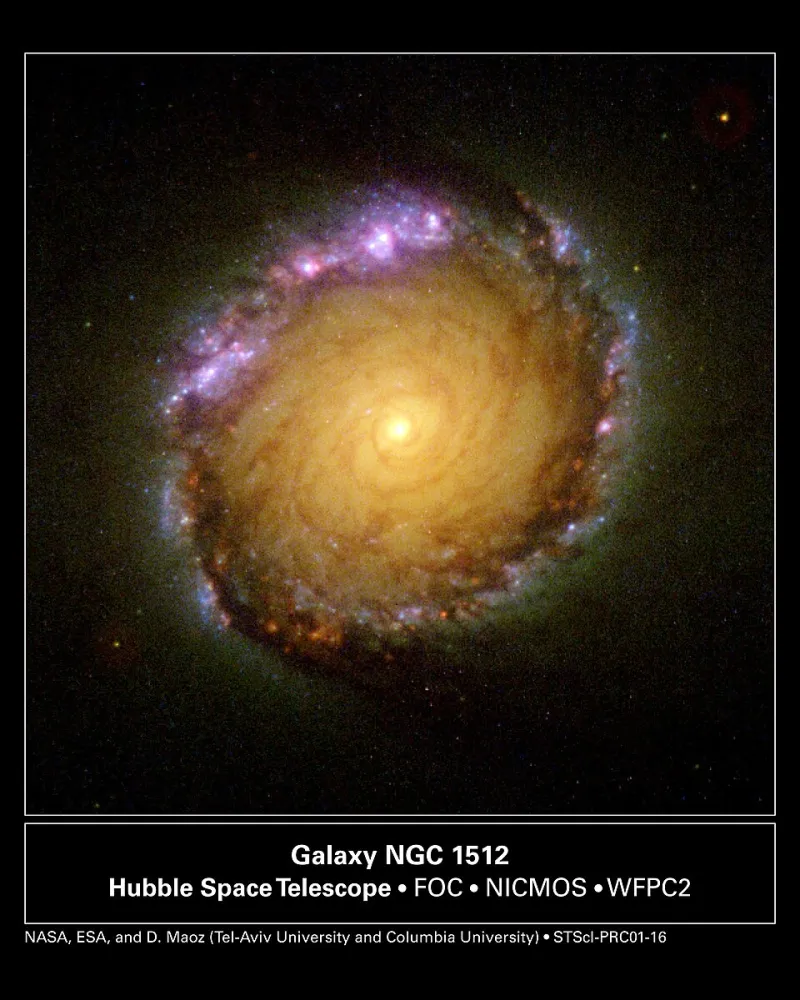
Photo: NASA, ESA, and D. Maoz (Tel-Aviv University and Columbia University), Public domain, via Wikimedia Commons
You'd think the brightest objects in the universe would be the easiest to spot. You'd be wrong.
Scattered across the cosmos are quasars and active galactic nuclei — galactic cores powered by feeding supermassive black holes — that pump out more energy than entire galaxies. And a shocking number of them are practically invisible to us. The culprit? Dust. Not the kind you sweep off your dashboard, but microscopic grains of silicate and carbon floating in vast clouds between stars. And just like the dust on your windshield at sunset, it scatters and absorbs light, turning cosmic beacons into cosmic blind spots.
Here's the kicker: astronomers now suspect that a huge fraction of all quasars — maybe even the majority — are hidden behind dust. That means the census of the universe's most energetic objects is, honestly, incomplete. But scientists have gotten crafty. Here are seven ways they're wiping the windshield.
1. Infrared Goggles: Seeing the Heat
Dust is great at blocking visible light, but it has a weakness: it absorbs that light, warms up, and re-emits the energy as infrared radiation. So while a dusty quasar might be invisible to your eyes, it practically glows in infrared.
That's why NASA's James Webb Space Telescope has been such a game-changer. JWST has been spotting dusty, growing supermassive black holes in the early universe that older telescopes completely missed. It's like switching from a flashlight to thermal imaging goggles — suddenly, everything hiding in the dark shows up in shades of heat.
2. X-Ray Vision: Punching Straight Through
If infrared is goggles, X-rays are a battering ram. The superheated gas spiraling into a black hole produces X-rays so energetic that dust can barely absorb them. Telescopes like NASA's Chandra X-ray Observatory and the European XRISM mission can detect the high-energy signature of a hidden quasar even when every other wavelength is blocked.
The catch? Some dust clouds are so thick that even X-rays get filtered. When astronomers find an X-ray source that's unusually faint for its size, that's often a clue they've found a truly buried monster — what scientists call a "Compton-thick" active galactic nucleus.
3. Radio Waves: The All-Weather Channel
Radio waves have wavelengths measured in centimeters or meters — millions of times longer than visible light. To dust grains, which are tiny by comparison, those waves just flow right past like a surfer gliding over a pebble. Radio telescopes like the Very Large Array in New Mexico can spot the jets and lobes of radio emission that buried quasars blast thousands of light-years into space, straight through the murk.
4. The Infrared Color Fingerprint
Here's a neat detective trick: even when dust hides a quasar, it leaves fingerprints. Dusty active galaxies have a distinctive color signature in infrared surveys — warm in some wavelengths, cool in others — that's different from ordinary star-forming galaxies. Astronomers sift through millions of infrared sources, hunting for that specific color recipe. It's like identifying a suspect by their shadow instead of their face.
5. Watching a Black Hole Eat Through the Smog
Sometimes, the dust itself gives the game away. When a black hole's radiation blasts into surrounding dust clouds, the dust heats up and produces a telltale glow at specific infrared wavelengths. Recent surveys have found populations of galaxies glowing with exactly this signature — evidence of black holes in the middle of a feeding frenzy behind a dust curtain.
6. Gravitational Lensing: Nature's Magnifying Glass
Every so often, a massive galaxy between us and a distant quasar bends the quasar's light around it, magnifying it like a giant natural lens. Occasionally, this cosmic lensing lets astronomers study hidden or faint quasars in detail they'd never achieve otherwise. It's rare, but when it happens, it's like finding a free telescope in exactly the right place.
7. The Hidden Population Problem
This last one isn't a technique so much as a growing realization. By combining all the methods above, astronomers keep finding more hidden quasars than models predicted — especially in the early universe. That matters, because black hole growth and galaxy evolution are tangled together. If we're missing most of the feeding black holes, we're missing a huge chunk of the story of how galaxies like our own Milky Way came to be.
The Bottom Line
Space grime is stubborn, but it's not unbeatable. Between JWST's infrared eyes, Chandra's X-ray vision, and radio telescopes here on Earth, astronomers are steadily wiping the cosmic windshield clean. And every dusty quasar they uncover is another piece of the puzzle — another data point in the story of how the universe grew up.
So the next time a cloudy night ruins your stargazing plans, take heart: even the universe deals with cloudy skies. The difference is, we're learning to see through them anyway.